How to Securely Connect AI Agents to Multiple Databases
AI agents need a unified way to query many systems. This guide explains how to connect agents to multiple databases with governance, performance, and reliability in mind.
With a connector per database, each carries its own policy, and the one with no policy returns unfiltered rows to the agent. A unified query layer applies one policy to every source, so the same query comes back filtered.
Connecting an AI agent to one database is simple. Connecting the same agent to many systems is harder. You need consistent query semantics, stable latency, and strict policy controls across every source.
Most teams start with direct per-database connectors inside agent code. That works for prototypes. It does not scale well for production. Every new source adds separate credentials, separate retry logic, and separate schema handling.
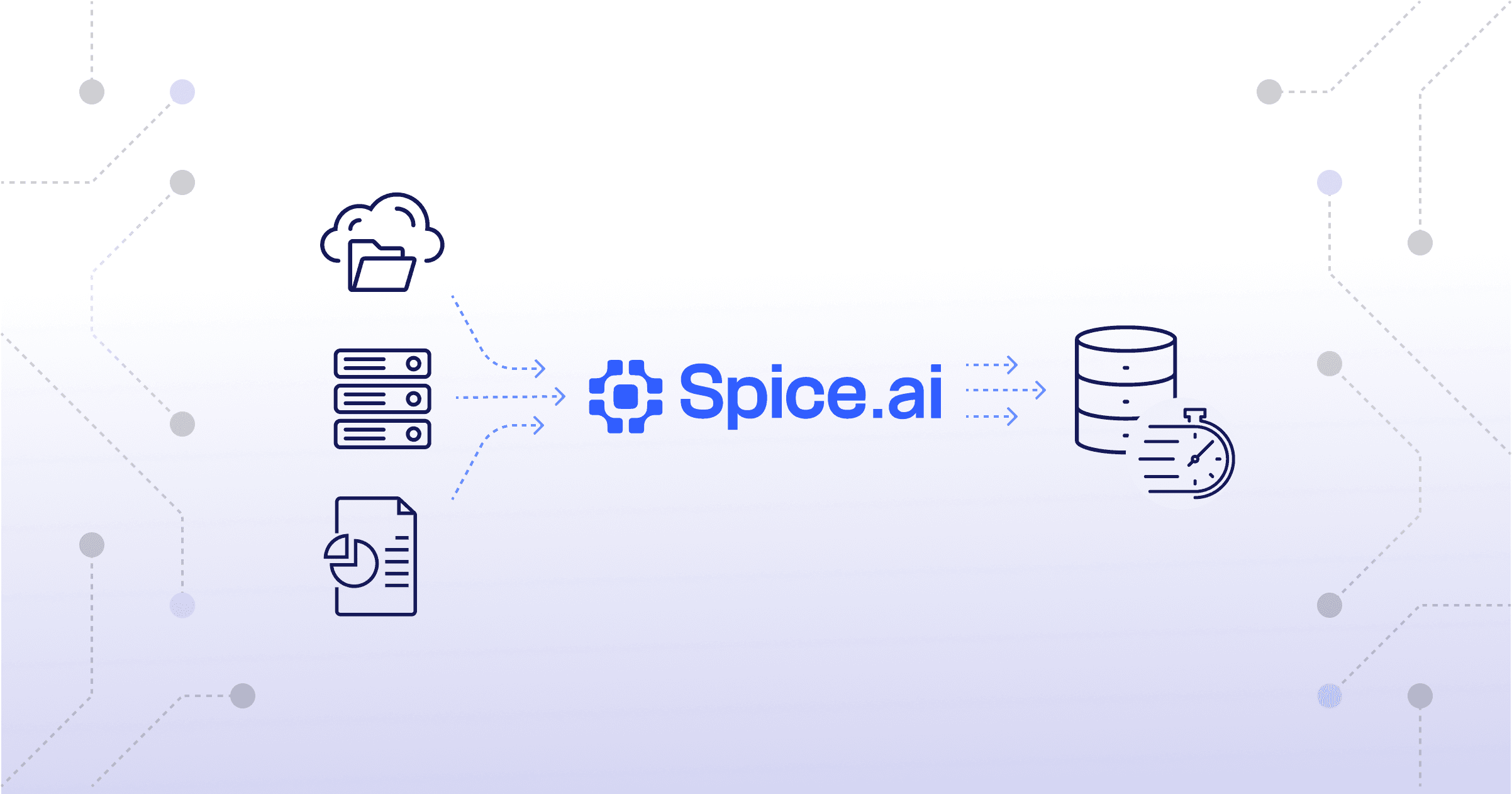
A better model is a unified retrieval layer in front of multiple sources. The agent talks to one interface. The retrieval layer handles federation, pushdown, policy, and observability. For the wider picture around this decision, see the guide to AI agent data access.
Why Multi-Database Agent Access Is Hard
Source systems differ. PostgreSQL, MySQL, Snowflake, and object storage have different dialect behavior, functions, and performance limits.
Agent query patterns are dynamic. Agents generate query shapes at runtime. A single workflow can call many datasets with changing filters.
Governance must be consistent. Security controls must apply evenly across all sources. Gaps often appear when each connector is managed independently.
Latency compounds fast. If one response triggers several database reads, tail latency rises quickly unless retrieval paths are tuned.
Reference Architecture
The most common production architecture uses four layers.
- Unified SQL or tool interface: Expose one query or tool surface to the agent. This keeps prompting and tool routing simple.
- Federated execution layer: Use SQL federation to route each query segment to the right source with predicate pushdown.
- Acceleration for hot paths: Use data acceleration for high-frequency reads. Keep source load stable while improving p95 latency.
- Policy and audit controls: Use scoped identities, field restrictions, and end-to-end tracing before broad rollout.
Step-by-Step Implementation
- Inventory databases and use cases: List each source, required freshness, and expected query volume. Separate read-only retrieval from action workflows.
- Normalize schema access: Create canonical dataset names and data contracts. Agents should not reason over raw source naming conventions.
- Connect sources through one retrieval layer: Use a federation layer that supports your required integrations. Validate pushdown and error behavior per source.
- Add access policies early: Define who can query what, by agent identity. Include table, column, and row filters where needed.
- Benchmark and add acceleration: Measure p95 latency and source pressure. Accelerate only the datasets that are hot and repetitive.
- Add observability and rollback paths: Track query failures, policy denials, and source saturation. Keep fallback behavior explicit.
Query Design Guidelines for Agents
Prefer stable semantic views. Expose business-level views rather than raw operational tables. This reduces prompt complexity and join errors.
Keep tool contracts narrow. Small, clear tool contracts are easier for agents to use correctly than broad generic query tools.
Enforce cost and safety limits. Set query timeout, row limits, and concurrency limits to prevent accidental overload.
Handle freshness explicitly. Document which datasets are real-time and which are delayed. Agent instructions should reference those contracts.
Securing Access Across Databases
Security controls are part of connection design, not a later add-on. Multi-database retrieval increases blast radius if identity and policy controls are weak.
Use dedicated identities. Give each agent its own identity and credentials. Shared service accounts reduce accountability and make incident containment harder.
Enforce scoped access policies. Apply table, column, and row filters by agent role. Use deny-by-default rules and explicit allowlists for data contracts.
Constrain query behavior. Set limits for execution time, row count, and concurrency. Guardrails reduce source pressure and lower misuse risk.
Apply output controls. Redact or filter sensitive fields before data is returned. Query-level authorization alone is not enough for safety.
Monitor denials and drift. Track policy denials, unusual query paths, and schema changes that can break safeguards.
Common Failure Modes
Direct connector sprawl. Teams add one connector per need and lose consistency in policy and retry behavior.
No source protection. Without pushdown checks and limits, agent traffic can overwhelm transactional systems.
Missing schema governance. When schemas drift, agent prompts can become invalid or unsafe.
Hidden cross-source joins. Some workloads perform expensive joins across remote systems. These need explicit optimization.
Advanced Topics
Source-Aware Query Planning and Pushdown Optimization
Federated query engines analyze inbound SQL queries from AI agents and decompose them into sub-plans for target databases. Source-aware planning evaluates the cost of remote execution versus local processing. The query engine pushes filter predicates, column projections, and aggregation operations down to source databases whenever supported.
Pushdown optimization prevents pulling large unfiltered datasets over the network. For operational databases like PostgreSQL or MySQL, predicate pushdown reduces scanned rows, source CPU utilization, and network payload sizes. When joining data across dissimilar stores, the planner executes local joins in memory using high-performance columnar formats.
Tiered Hybrid Execution: Live Federation vs. CDC Acceleration
Not every dataset requires live federated queries. Multi-database agent architectures implement a tiered execution model combining live federation with change data capture (CDC) acceleration.
Live federation queries remote systems directly for ad-hoc or low-frequency requests. For high-volume operational tables, background CDC workers tail transaction logs and materialize local columnar caches. The agent queries the local cache with sub-millisecond response times, protecting source databases from query bursts. The guide on connecting AI agents to live operational data without ETL covers this tiered setup step by step.
Cross-Database Lineage, Audit Trails, and Policy Enforcement
Production agent platforms require end-to-end observability across all database touchpoints. Query gateways instrument every agent request with unique session identifiers, tracing execution from agent prompting down to individual table reads.
Policy engines evaluate query syntax against role-based access control rules before executing remote requests. If an agent attempts an unauthorized join across restricted schemas, the query gateway blocks execution and logs a policy denial event. Detailed audit logs record which data records contributed to each agent output.
Connecting Multiple Databases with Spice
Spice provides one query layer across operational and analytical systems. Teams can connect many sources, apply scoped policies, and tune acceleration where latency matters. The same runtime supports governed tool access for MCP gateway workloads and supports secure serving patterns for AI agents.
A runnable starting point is the Federated SQL Query recipe in the Spice cookbook. It joins a PostgreSQL table with S3 data in one query. The Model Context Protocol with Spice recipe lists the built-in sql, list_datasets, and table_schema tools that agents call over MCP.
For deployment planning, see Spice Cloud pricing.
Connecting AI Agents to Multiple Databases FAQ
Direct connections can work for prototypes, but they increase complexity in production. A unified retrieval layer usually improves governance, observability, and reliability.
There is no fixed limit. Reliability depends on query design, source capacity, and policy controls. Most teams start with a small set of high-value sources and expand gradually.
Use predicate pushdown, query limits, and acceleration for hot paths. Monitor source latency and denial events, then tune policies before scaling traffic.
Not always. Federation can serve many use cases without full ETL. Teams often combine live federation with selective acceleration for performance and cost control.
Track p95 latency, query error rate, source load, and policy denials by agent identity. Those metrics usually reveal bottlenecks faster than average latency alone.
Learn more about multi-database agent access
Docs and technical posts on federation, acceleration, and governed access for AI agent retrieval.
Query Federation Docs
Learn how to configure federated queries across data sources and tune pushdown behavior.

Getting Started with Spice.ai SQL Query Federation & Acceleration
Learn how to federate and accelerate queries across operational and analytical systems with one runtime.
Multi-Tenancy for AI Agents Without Pipelines
How teams isolate AI agent workloads while keeping real-time access to production data systems.

See Spice in action
Get a guided walkthrough of how development teams use Spice to query, accelerate, and integrate AI for mission-critical workloads.
Get a demo (opens in a new tab)