Analytics Replica
Add a sandboxed, analytics-ready replica alongside PostgreSQL, MySQL, and MongoDB in minutes. Spice keeps it fresh with high-throughput change data capture for sub-second queries, no ETL, and no analytical load on your production database.
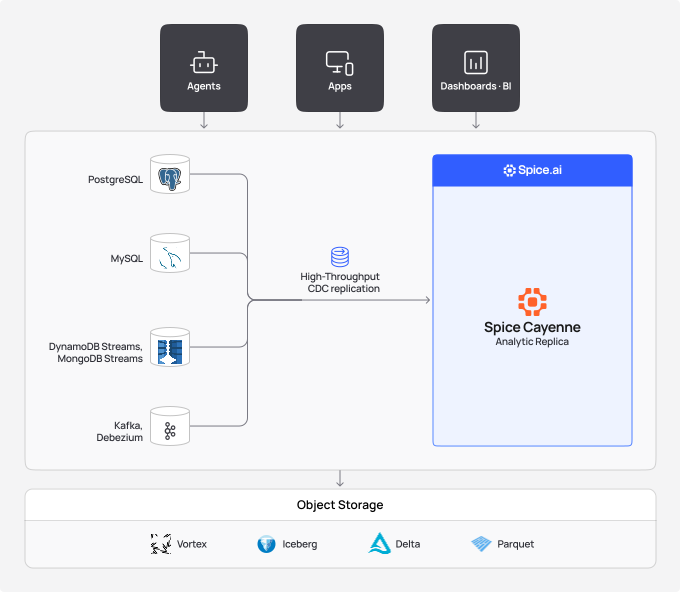
Add analytics to your operational data, without ETL
Point Spice at a live operational database and it maintains a continuously-updated analytics replica. Start with one table, then compose across sources and join replicated datasets in a single SQL query.

Zero load on production
Spice replicates from the native change log, so analytical queries and AI agents run against the sandboxed replica. Your operational database never executes a single analytical query.
Explore CDC replication

Real-time freshness,
no pipelines
Native replication from the PostgreSQL WAL, MySQL binlog, and MongoDB oplog delivers single-digit-second freshness. No Debezium or external streaming layer required.
See real-time CDC

Sub-second query
performance
Spice materializes the replica with the Spice Cayenne accelerator, built on Vortex. Cayenne is 1.4x faster than DuckDB with 3x less memory, and DuckDB and SQLite are also supported.
Explore Spice Cayenne (opens in a new tab)
Real-time analytics, zero production impact
0
analytical queries run on your production database, ever
2.0s
end-to-end freshness under load, from source commit to query-ready
1.4x
faster than DuckDB with 3x less memory on Spice Cayenne
How the analytics replica works
Spice adds an analytical node to your stack in three steps, and it is incrementally adoptable. Start with a single store or table, replicate its changes into a Spice dataset, then compose and join across replicated sources.
- Connect. Point Spice at an operational database. Spice bootstraps a snapshot and manages replication slots automatically.
- Replicate. Committed writes, updates, and deletes stream from the native change log into an accelerated Spice dataset, with no query load on production.
- Query. Run analytics with familiar SQL from any client, joining across replicated datasets and other federated sources.
For append-only sources such as Kafka, Spice also supports event-stream replication with upsert semantics. Learn more in the Spice 2.0 launch post and the SQL Federation and Acceleration platform. The general pattern, including freshness controls and recovery paths, is covered in analytics replicas for operational data.
Connect the analytics tools your team already uses
The replica speaks open protocols, so your existing stack connects with no rewrites. Query from Microsoft Power BI through the native Spice connector built on the Flight SQL ADBC driver, and from Tableau, Looker, and Apache Superset over Arrow Flight SQL, ODBC, and JDBC. Build in code with the SpicePy Python library, plus Go, Rust, Java, and JavaScript SDKs. Extend queries with SQL, WASM, and HTTP user-defined functions that auto-register as tools and propagate across the cluster, and federate Apache Spark through Spark Connect.

Query operational data with SQL in the Spice portal
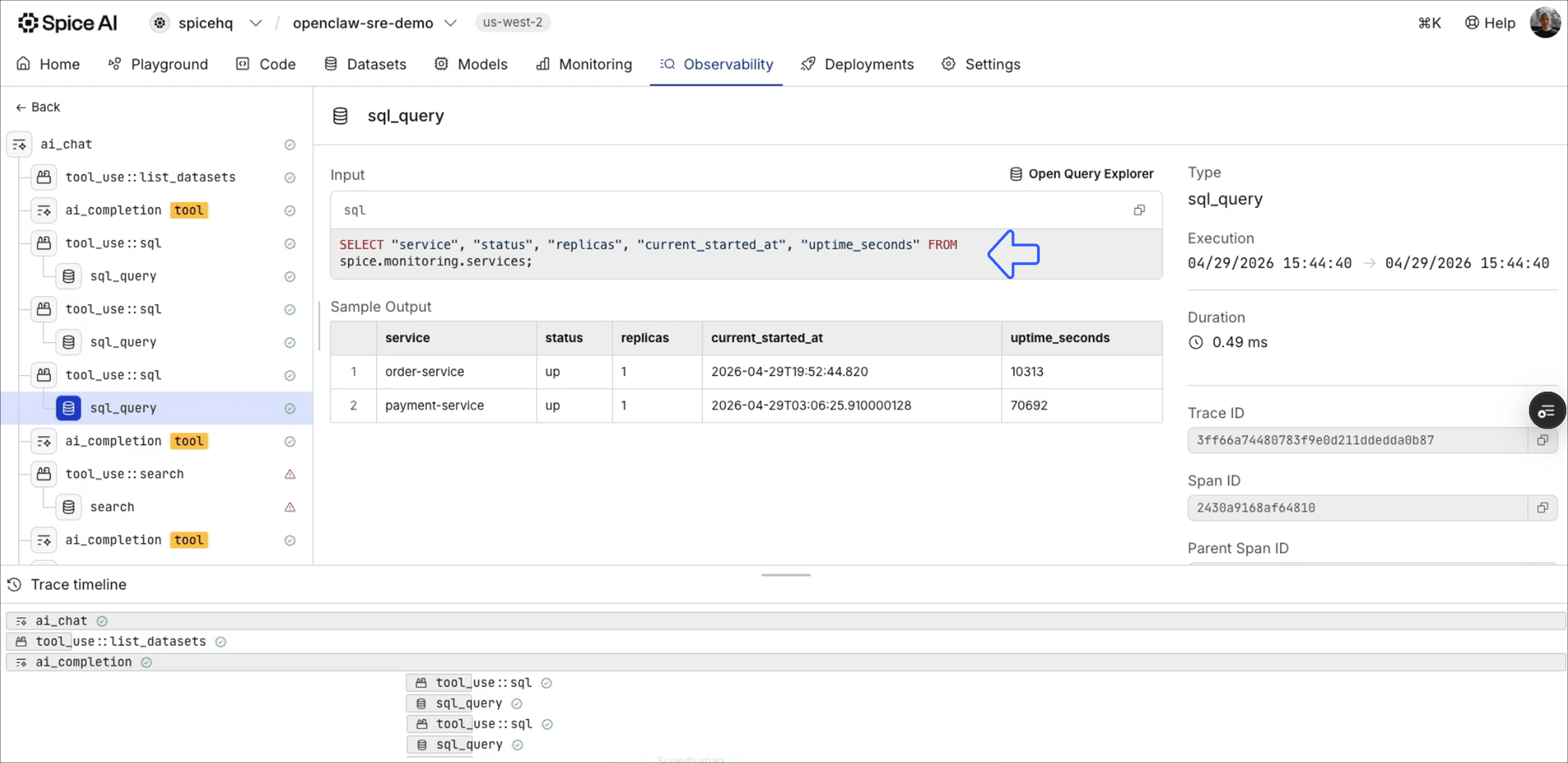
Explore datasets, run SQL, and inspect results in the Spice Cloud portal. Built-in observability traces every query with execution timing and lineage, so you can validate freshness and tune performance against the replica instead of production.
Proven in production
Teams building real-time systems at scale run Spice to serve analytics and AI from operational data.

100x
Faster queries
“It just spins up and works, which is really nice. The responsiveness is amazing, which is a huge gain for the customer.”
Darin Douglass
Principal Software Engineer, Barracuda
Learn how Barracuda gained 100x faster query responses and reduced costs 50% with Spice

“Spice opened the door to take these critical control-plane datasets and move them next to our services in the runtime path.”
Peter Janovsky
Software Architect, Twilio
FAQs
Learn how an analytics replica keeps operational data query-ready without ETL or load on production.
An analytics replica is a read-optimized, continuously-updated copy of your operational data that Spice maintains alongside your database. Analytical queries, dashboards, and AI agents run against the replica instead of production, so heavy reads never contend with your transactional workload.
No. Spice replicates from the native change log, the PostgreSQL WAL, MySQL binlog, or MongoDB oplog, rather than polling with queries. In benchmarks, the operational database sustained its full transactional workload, and Spice served all analytics from the replica. Production never executed a single analytical query.
Spice ships native replication for PostgreSQL, MySQL, MongoDB, and DynamoDB, plus append-only event streams from systems like Kafka with upsert semantics. Debezium is also supported. See the CDC documentation for the full list.
End-to-end freshness is single-digit seconds under load. For CDC that covers inserts, updates, and deletes, freshness is roughly 2.0 seconds from source commit to exactly-correct results on the replica.
No. Replication is built into the runtime, so there are no external ETL jobs, no Debezium to operate, and no streaming layer to manage. It is incrementally adoptable: start with one table and expand as needed.
Any tool that speaks Arrow Flight SQL, ODBC, or JDBC. That includes Microsoft Power BI through the native Spice connector, along with Tableau, Looker, and Apache Superset. In code, use the SpicePy Python library or the Go, Rust, Java, and JavaScript SDKs, and extend queries with SQL, WASM, and HTTP user-defined functions.
Sub-second on accelerated working sets. Spice materializes the replica with the Spice Cayenne accelerator, built on the Vortex columnar format, which is 1.4x faster than DuckDB with 3x less memory. DuckDB and SQLite acceleration engines are also supported.
Yes. The Spice runtime is open source under the Apache 2.0 license, including federation, acceleration with Cayenne, hybrid search, and AI integration. Spice Cloud offers a fully managed option, and Spice.ai Enterprise adds self-hosted deployment with SSO, RBAC, and audit logs.
See Spice in action
Walk through your use case with an engineer and see how Spice handles federation, acceleration, and AI integration for production workloads.
Talk to an engineer (opens in a new tab)