How to Connect AI Agents to Live Operational Data Without ETL
AI agents perform best with current operational context. This guide outlines an objective architecture for connecting agents to live data sources without relying on batch ETL pipelines.
Batch ETL holds an order's change until its next scheduled run, so the agent reading the warehouse gets a stale answer. A change stream carries the same change into a local copy, so the agent on the live path reads the current state.
Many enterprise teams are trying to give AI agents access to operational systems such as ticketing tools, order platforms, user databases, and internal APIs. The common first approach is to route everything through existing ETL pipelines and a central warehouse. That can work for batch analytics, but it is often a poor fit for agent workloads.
Agents need fresher data, lower read latency, and tighter access controls than many dashboard-style workloads. This guide explains how to connect agents to live operational data without relying on batch ETL as the primary path.
Why Batch ETL Becomes a Bottleneck for Agent Workloads
ETL introduces staleness windows
By design, ETL runs on a schedule. If your pipeline updates every hour, agent responses can be up to an hour behind operational reality.
Agent query patterns are dynamic
BI dashboards run known query templates. Agents generate context-dependent tool calls, often with different filters and joins each time.
Latency compounds across tool calls
One response may trigger several reads. A few slow calls can push end-to-end response time beyond acceptable user-facing thresholds.
Governance scope changes
Agents carry credentials and can act autonomously. Data access design needs explicit policy boundaries and auditability for each agent path.
Reference Architecture Without ETL-First Data Access
The most common production pattern has four parts.
1. Federated query layer
Use SQL federation and acceleration to query across operational databases, APIs, and analytical systems through one interface. When expanding across heterogeneous backends, review patterns for connecting AI agents to multiple databases. This avoids waiting for a central ingestion pipeline before data becomes usable.
2. Local acceleration for hot datasets
For high-frequency reads, materialize selected datasets in a local acceleration layer and refresh them continuously or on short intervals. This improves p95 latency and reduces repeated read load on source systems.
3. Change-driven refresh
Use real-time change data capture or equivalent change streams to keep accelerated datasets synchronized. See the real-time analytics guide for AI agents for architecture guidance. This gives a bounded freshness window instead of a large batch ETL delay.
4. Policy and identity controls
Map each agent to scoped credentials and enforce least-privilege rules in the retrieval layer. If agents are exposed through MCP server gateway patterns, keep policy and audit controls aligned between the gateway and data layer.
Step-by-Step Implementation Approach
Step 1: Inventory source systems and freshness needs
List all systems agents need to query and classify each by required freshness. Some datasets need seconds-level updates, while others can tolerate minutes or hours.
Step 2: Start with read-only federation
Connect sources and validate read paths first. Measure baseline latency and source query impact before introducing acceleration.
Step 3: Add acceleration where it changes outcomes
Accelerate only datasets that are high-frequency, latency-sensitive, or expensive to query repeatedly from source systems.
Step 4: Define freshness contracts
Document refresh intervals and expected lag per dataset. Agent prompts and downstream business logic should rely on explicit freshness contracts, not assumptions.
Step 5: Harden governance and observability
Add role-based access controls, audit logs, query tracing, and per-agent usage metrics before broad rollout.
Comparison: ETL-First vs Live Federation Paths
| Dimension | ETL-first access path | Live federation + acceleration path |
|---|---|---|
| Freshness | Batch-dependent | Near real-time with bounded lag |
| Time to first query | Slower (pipeline setup) | Faster (connect and query) |
| Latency for hot reads | Variable, often warehouse dependent | Lower with local acceleration |
| Source read pressure | Lower during serving | Controlled via pushdown and acceleration |
| Operational model | Pipeline-heavy | Query runtime + refresh controls |
| Best fit | Historical reporting | Interactive agent retrieval |
Common Failure Modes and How to Avoid Them
Treating all datasets the same
Not every table needs the same refresh or acceleration policy. Use workload-specific classes instead of one global setting.
Missing source protection limits
Direct live querying can overload fragile systems if limits are not configured. Enforce concurrency controls and use acceleration for heavy paths.
Split policy ownership
If gateway and data layer policies are managed separately without coordination, access drift appears over time. Keep policy mapping explicit and test it continuously.
Measuring only average latency
p50 can look good while p95 and timeout rates fail user experience. Track tail latency and error distribution for each source and each agent.
Advanced Topics
Per-agent isolation models
Some teams deploy one shared runtime, while others deploy sidecar or microservice instances per agent or per team. Shared models improve utilization. Isolated models reduce blast radius and simplify credential scoping. The right choice depends on risk tolerance and operational capacity.
Hybrid architecture with selective ETL
This guide focuses on non-ETL primary paths for agent retrieval, but ETL still has a role. Many teams keep ETL for long-horizon analytics and compliance while using live federation plus acceleration for operational agent workflows.
Cost modeling beyond infrastructure line items
Include engineering labor, incident cost, and source-system impact when comparing architectures. Lower infrastructure cost can be offset by higher operational burden if policy and observability are weak.
How Spice Fits This Pattern
Spice combines federated SQL querying with local acceleration. Teams serve agents from current operational data without waiting for batch ETL cycles. It connects to sources across integrations, supports tuned refresh behavior, and can be deployed in sidecar or microservice patterns for scoped runtime boundaries.
For teams building agent retrieval paths, this approach provides live access where freshness matters. It retains selective ETL where historical materialization adds value. For commercial planning, see Spice Cloud pricing.
For live operational data, the PostgreSQL CDC recipe in the Spice cookbook streams table changes into an accelerated copy without a pipeline. The Spice as MCP Server recipe shows how an MCP client reaches accelerated data and tools through one endpoint.
Connecting Agents to Live Data Without ETL FAQ
Use predicate pushdown, concurrency limits, and local acceleration for hot datasets. Monitor source load continuously and move high-frequency paths to accelerated reads when needed.
Track p95 latency, timeout rate, freshness lag, source error rate, and policy-denied requests. These metrics are more predictive of agent retrieval quality than average latency alone.
It depends on your reliability and security requirements. Per-agent runtimes improve isolation and blast-radius control. Shared runtimes can reduce cost and simplify management. Many teams use a mix by workload tier.
Start with one high-value workflow, connect required sources through federation, and measure baseline latency. Then add acceleration only where tail latency or source pressure indicates a bottleneck.
Learn more about live agent data access
Documentation and technical resources on federation, acceleration, and operational patterns for AI agent retrieval.
Query Federation Docs
Learn how to federate queries across operational and analytical systems with a single SQL layer.

Building an Enterprise SRE Agent with OpenClaw and Spice
How to build an OpenClaw SRE with Spice for safe, unified, and observable access to production data, demonstrated with real-world incident workflows.
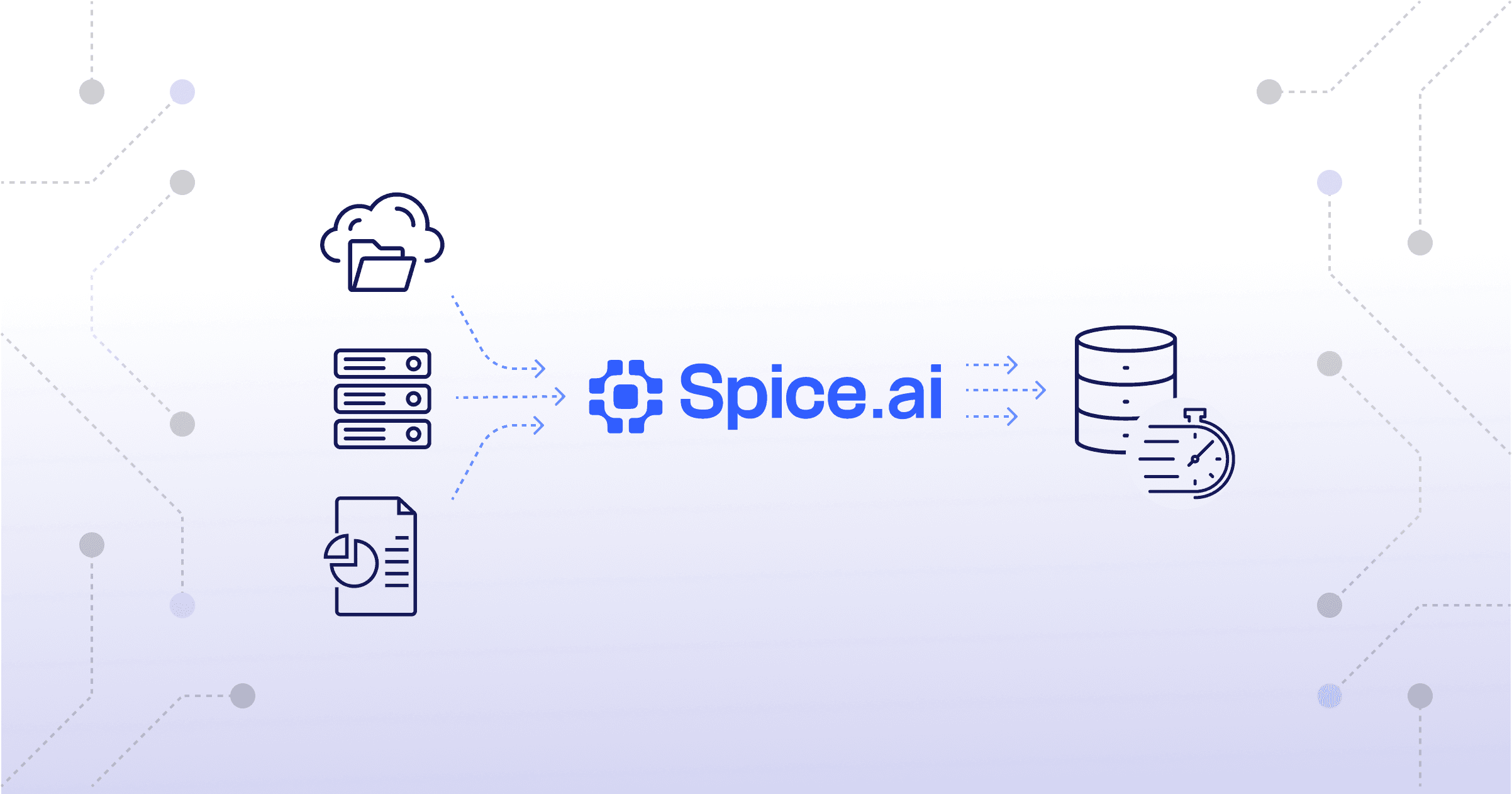
Getting Started with Spice.ai SQL Query Federation & Acceleration
Learn how to use Spice.ai to federate and accelerate queries across operational and analytical systems with zero ETL.
See Spice in action
Walk through your use case with an engineer and see how Spice handles federation, acceleration, and AI integration for production workloads.
Talk to an engineer (opens in a new tab)