A platform built on partnerships
The Spice AI partner program works with cloud, data, AI model, and developer-tool providers to build integrations with the Spice runtime. Partners get engineering support, joint go-to-market, and co-marketing for SQL federation, acceleration, search, and AI workloads.
Partner with Spice AI
A Spice integration lets your customers query your platform with SQL, join it with data in other systems, and serve it to AI applications from a local accelerated copy. Spice partners include cloud providers, databases, data warehouses, AI model providers, observability platforms, and productivity tools. Each integration ships as an open-source data connector, catalog connector, or model provider in the Spice runtime.
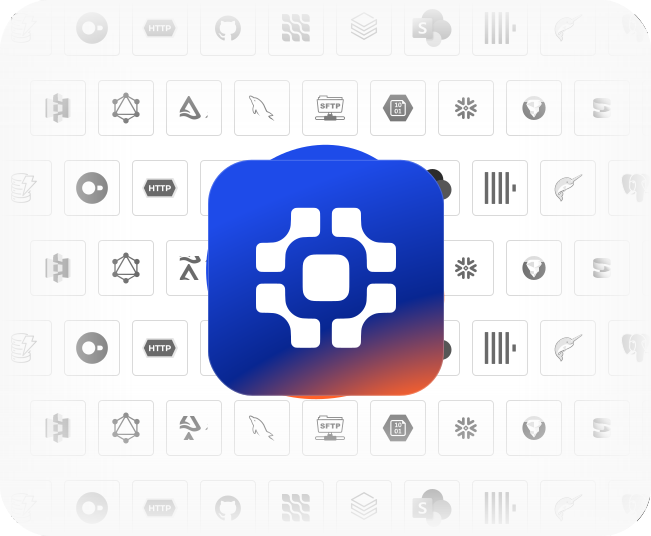
Data and AI platforms Spice integrates with
Spice connects to model providers, databases, warehouses, lakehouses, and object stores through components in the open-source runtime. Each card describes what the integration does in Spice.

Anthropic
Spice serves Anthropic Claude models through its Anthropic model provider. Applications call Claude through the OpenAI-compatible Spice API, and the model can query Spice datasets with built-in SQL and search tools.

OpenAI
The OpenAI model provider connects Spice to OpenAI models and to any OpenAI-compatible endpoint, such as NVIDIA NIM. Spice also generates embeddings with OpenAI embedding models for vector search.

Hugging Face
Spice loads open-weight models from Hugging Face and runs them locally next to the data. Local inference uses CUDA or Apple Metal acceleration when the hardware has it.

GitHub
The GitHub data connector exposes repository files, issues, pull requests, and commits as SQL tables. Teams accelerate and search this data, or give AI agents access to it.

MongoDB
The MongoDB data connector runs federated SQL queries over MongoDB collections. Spice can accelerate a collection locally and join it with data from relational databases, warehouses, and object stores.

Snowflake
The Snowflake data connector runs federated SQL queries against Snowflake tables. Spice accelerates frequently read tables locally, so applications read them without a warehouse round trip.

Databricks
Spice reads Databricks tables through Spark Connect, a SQL warehouse, or directly from Delta Lake files. The Unity Catalog connector registers catalog tables as Spice datasets.

Amazon S3
The S3 data connector queries Parquet, CSV, and other files in Amazon S3 and S3-compatible stores. Spice also stores and searches embeddings with Amazon S3 Vectors.
Why partner with Spice AI
Spice partners get engineering, sales, and marketing support for integrations with the Spice runtime.

Technical integration support
Build an integration with help from Spice engineers. Integrations add a data connector, catalog connector, or model provider to the runtime for federation, acceleration, search, or AI workloads.
Contact the partner team

Sales and GTM collaboration
Work with the Spice sales team on joint accounts, solution design, and marketplace listings.
Contact the partner team

Co-marketing opportunities
Publish joint content, demos, webinars, and campaigns for developers and enterprise teams that build data and AI applications.
Contact the partner team
FAQs
Common questions about the Spice AI partner program and partner integrations.
Send a request to the Spice team through the contact page. Describe your platform and the integration you want to build. The Spice partner team then works with you on technical scope, go-to-market, and co-marketing.
Spice partners include cloud providers, databases, data warehouses, lakehouse platforms, AI model providers, and developer tools. Dedicated pages describe the AWS, Databricks, and NetApp integrations. The integrations catalog lists the available data connectors.
An integration is a component in the open-source Spice runtime. A data connector exposes a source as SQL tables, and a catalog connector discovers tables in a catalog. A model provider connects Spice to an LLM or embedding model. Customers turn on an integration with a few lines of YAML in their Spicepod configuration.
Yes. The Spice runtime is open source under the Apache 2.0 license, and its code is on GitHub. Partners can read the code for existing connectors and model providers. They then submit a new component as a pull request. New components go through the same review process as other runtime changes.
Yes. Spice can copy a dataset from a data connector into a local accelerator such as Arrow, DuckDB, SQLite, or Spice Cayenne. Queries then read the local copy and do not wait for a network round trip to the partner platform. See data acceleration for how the local copy stays current.
Proven in production
Enterprises trust Spice to run data-intensive workloads.




“Spice opened the door to take these critical control-plane datasets and move them next to our services in the runtime path.”
Peter Janovsky
Software Architect, Twilio

0x
Faster queries
“It just spins up and works, which is really nice. The responsiveness is amazing, which is a huge gain for the customer.”
Darin Douglass
Principal Software Engineer, Barracuda
Learn how Barracuda gained 100x faster query responses and reduced costs 50% with Spice

“Partnering with Spice AI has transformed how NRC Health delivers AI-driven insights. By unifying siloed data across systems, we accelerated AI feature development, reducing time-to-market from months to weeks - and sometimes days. With predictable costs and faster innovation, Spice isn't just solving some of our data and AI challenges - it's helping us redefine personalized healthcare.”
Tim Ottersburg
VP of Technology, NRC Health
See Spice in action
Walk through your use case with an engineer and see how Spice handles federation, acceleration, and AI integration for production workloads.
Talk to an engineer