Real-time data and AI for SaaS applications
Spice is a portable SQL query, search, and AI runtime for SaaS applications. Query warehouses, databases, and object storage in one SQL statement. Accelerate active data next to your app for millisecond reads, in your own cloud or on Spice Cloud.
Do more with your data
100x
up to 100x faster queries
80%
up to 80% cost savings on data lakehouse spend
2x
increase in data reliability for critical workloads
Software development teams face a data bottleneck
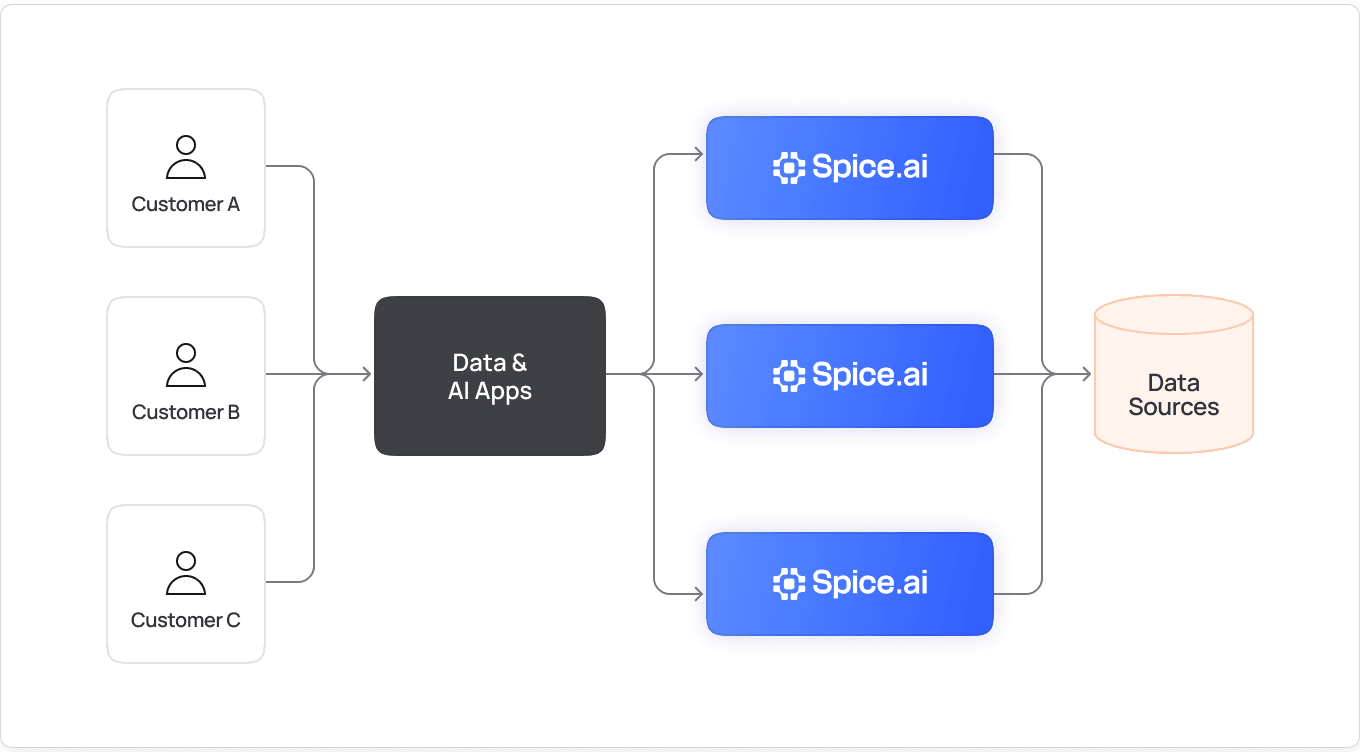
SaaS applications read customer data from many warehouses, databases, and object stores. ETL pipelines, separate analytics stacks, and calls to remote databases slow feature delivery and add latency. Each new tenant or source adds one more pipeline to run. Teams need governed, low-latency access to that data without adding new systems.

Deliver faster and more resilient software
Unify data, accelerate performance, and embed AI directly into your app workflows.
Unified query and search layer
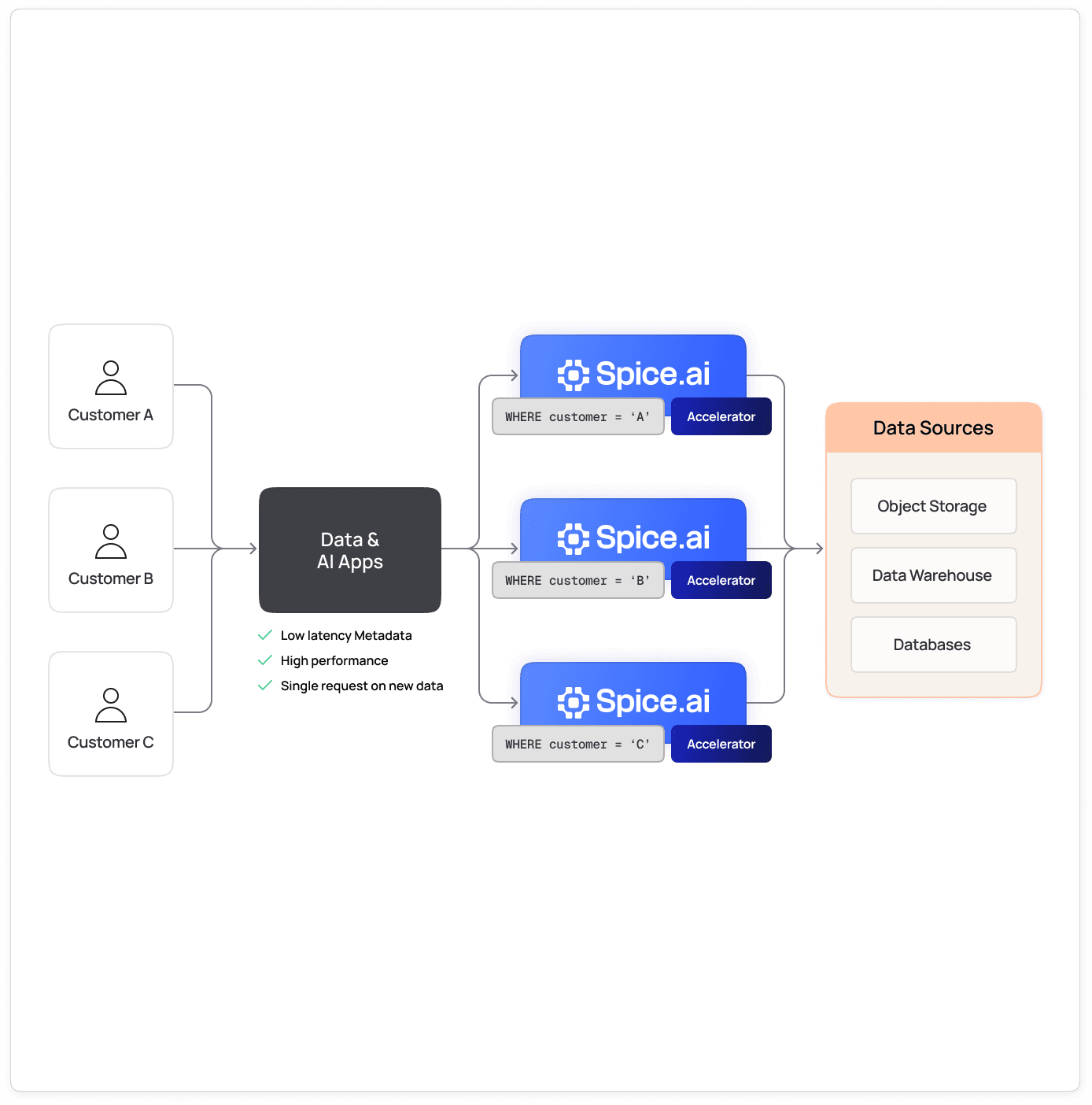
Query your warehouse, databases, and object storage from one runtime with one SQL statement. Remove fragile integration code from your application logic.
Sharded deployment for secure multi-tenancy
Run one Spice runtime per customer, region, or workload, or share one runtime across smaller tenants. Give large tenants dedicated resources and configuration for performance, security, and resiliency.
CDN-like performance
Accelerate active datasets next to your application for millisecond reads under high traffic. From Spice v2.4, an eligible persisted acceleration keeps serving queries after a restart while its source is unavailable.
Built-in AI and automation
Call hosted or local LLMs and run hybrid search in the same runtime that serves your app data. Build recommendations, summaries, and agents, and trace each model and tool call in task history.
Purpose-built for SaaS speed and scale
Spice federates, accelerates, searches, and serves AI from one runtime built for always-on, high-traffic SaaS applications.

Accelerated Performance
Local acceleration in Spice Cayenne, DuckDB, SQLite, Arrow, or PostgreSQL for millisecond reads.

Real-Time Data Sync
Change data capture streams updates from PostgreSQL, MySQL, MongoDB, and DynamoDB into accelerated tables.

Embedded AI
Run LLMs and hybrid vector and full-text search inside the runtime for AI features.

Observability & Governance
Task history records each query, model call, and tool call. OpenTelemetry exports runtime metrics.

Deployment Flexibility
Run Spice anywhere: as a sidecar, microservice, cluster, or on the managed Spice Cloud Platform.

Developer-First Design
Define datasets and models in one spicepod.yaml file. Query with SQL over HTTP, Arrow Flight SQL, ADBC, JDBC, or ODBC.
Deployed in production
Run data-intensive workloads on a high-performance engine trusted by teams building real-time systems at scale.

“Spice opened the door to take these critical control-plane datasets and move them next to our services in the runtime path.”
Peter Janovsky
Software Architect, Twilio

100x
Faster queries
“It just spins up and works, which is really nice. The responsiveness is amazing, which is a huge gain for the customer.”
Darin Douglass
Principal Software Engineer, Barracuda
Learn how Barracuda gained 100x faster query responses and reduced costs 50% with Spice

“Partnering with Spice AI has transformed how NRC Health delivers AI-driven insights. By unifying siloed data across systems, we accelerated AI feature development, reducing time-to-market from months to weeks - and sometimes days. With predictable costs and faster innovation, Spice isn't just solving some of our data and AI challenges - it's helping us redefine personalized healthcare.”
Tim Ottersburg
VP of Technology, NRC Health
Trusted by global enterprises




Power real-time SaaS at scale
Guides and examples to learn more about querying data, building apps, and integrating AI with Spice.
Data Acceleration with DuckDB Cookbook
This recipe will walkthrough how to accelerate a local copy of the taxi trips dataset stored in S3 using DuckDB as the data accelerator engine.

Spice Federation and Acceleration Docs
Learn how to get started with Spice federation and acceleration. Query, join, and accelerate data using SQL from multiple sources, including databases, data warehouses, and data lakes

Making Object Storage Operational for Real-Time and AI Workloads
TLDR Introduction Although legacy systems and workflows remain common, many enterprises are re-evaluating their architectures to meet new demands – driven in part, but not exclusively, by AI – that require support for more data-intensive and real-time applications. The underlying storage needs for these novel workloads are generally outside the bounds of a traditional operational […]
FAQs
Common questions about Spice for SaaS product, platform, and data teams
A real-time data platform for SaaS applications serves fresh customer data to product features at low latency. Spice does this with one runtime for SQL federation and acceleration, search, and LLM inference. It queries PostgreSQL, Snowflake, Amazon S3, and other supported sources in place, with no new ETL pipeline. It copies active data into a local accelerator for millisecond reads.
Spice isolates tenants at three levels, which the multi-tenancy guide compares. Query-time filtering in a shared runtime is the weakest level, because one missed filter can expose rows from another tenant. A separate dataset for each tenant puts the boundary in the Spicepod configuration. One runtime per tenant is the strongest level, with its own sources, accelerations, and secrets.
Spice uses change data capture (CDC) to apply inserts, updates, and deletes to accelerated datasets. PostgreSQL, MySQL, MongoDB, and DynamoDB datasets read changes natively when they set refresh_mode: changes. For other databases, Spice applies Debezium change events, pushed over HTTP to a cdc: dataset or read from Kafka. Your application reads the local copy, so fresh data does not add query latency.
Yes, for eligible persisted accelerations in Spice v2.4 and later. At startup, Spice loads the existing acceleration and serves its rows while the source is unavailable. An eligible dataset is read-only, persists across restarts, and uses full refresh or append with a time_column. CDC datasets, datasets with search columns, and the other cases in the data refresh docs still wait for the source.
Call hosted or local LLMs through the Spice OpenAI-compatible API, in the same runtime that serves your app data. Models can query datasets with SQL tools and use hybrid search over vector and full-text indexes. Task history records each query, model call, and tool call for review. You do not deploy or sync a separate AI stack.
See Spice in action
Walk through your use case with an engineer and see how Spice handles federation, acceleration, and AI integration for production workloads.
Talk to an engineer (opens in a new tab)