How to Migrate Data and Search Infrastructure Across Clouds
A data and search infrastructure migration moves databases, data APIs, and search systems between on-premises environments and clouds, usually while both sides stay in production.
Clients query one endpoint while the team replicates data to the cloud, rebuilds the search index there and compares results from both sides. Reads then move one client group at a time, writes move last, and the endpoint never changes.
A data and search infrastructure migration moves storage, query, and retrieval systems from one environment to another. The scope covers operational databases, analytical platforms, search engines, and the data APIs in front of them. Three shapes cover most projects: on-premises to cloud, cloud to on-premises, and one cloud to another.
Copying bytes is the simple part. The difficult part is keeping applications correct while two systems hold the same data. Queries, index definitions, credentials, network routes, and client libraries all point at the old system.
Most migration failures happen at the cutover, not at the copy. A team copies a warehouse in a weekend, then spends six months on query differences, permission gaps, and search results that no longer match.
This guide covers the migration shapes, the patterns teams choose between, a staged plan, validation methods, and the costs that appear during the move.
What Is a Data and Search Infrastructure Migration?
Operational database migrations
An operational database migration moves the system of record. A common move replaces on-premises MySQL, PostgreSQL, or Microsoft SQL Server with a managed cloud database such as Amazon Aurora or Azure Cosmos DB.
The engine change is rarely the hard part. The client estate is. Every application and job that reads the old database must be repointed, tested, and released.
Analytical platform migrations
An analytical platform migration moves tables, files, and the engines that read them. The scope usually includes object storage, warehouses, lakehouse catalogs, and the pipelines between them.
Each layer has its own migration path. Object storage copies cleanly between providers. Warehouse SQL dialects and permission models rarely copy at all.
Search platform migrations
A search platform migration moves indexes and the retrieval behavior built on them. The scope covers full-text indexes, vector indexes, ranking configuration, analyzers, and synonym lists.
Search adds a correctness problem that data migrations do not have. Two engines can hold identical documents and still return different results for the same query.
Data API migrations
Many datasets reach applications through an API rather than a database port. REST endpoints, GraphQL services, and internal data services all carry production data.
An API migration changes a contract, not just an address. Field names, pagination, error codes, and rate limits usually differ between the old service and the new one.
Why Are These Migrations Hard?
Data gravity and egress cost
Large datasets are expensive to move, and a second move repeats the whole cost. Cloud providers bill outbound transfer, so a cross-cloud copy carries a direct line-item cost.
Data gravity also shapes compute placement. Applications, pipelines, and dashboards usually run next to the data, so moving a dataset forces changes in the systems around it.
Application coupling
Clients hold connection strings, SQL dialect assumptions, index names, and driver versions. Each one is a place the migration can break.
A plan that requires an application change for every client scales badly. Ten services are manageable. Two hundred are not.
Correctness during a dual run
Both systems hold the same data during the transition. Writes must reach both systems, or one must replicate from the other. An error here produces silent divergence that surfaces weeks later.
Relevance parity for search
Search results depend on tokenization, stemming, scoring, field weights, and the embedding model. A new engine with the same documents can rank them differently. Users notice a ranking change faster than a latency change.
Compliance and data residency
Regulated data has rules about where it lives and who can read it. A dual run doubles the number of places that data exists. Auditors treat the second copy as a system in scope, not as a temporary artifact.
Which Migration Patterns Apply?
Five patterns cover most projects. Teams usually combine two or three of them.
| Pattern | Client changes | Cutover risk | Rollback path | Best fit |
|---|---|---|---|---|
| Lift and shift | Low | High | Restore from backup | Same engine on both sides |
| Dual write | High | Medium | Stop writing to the target | Few write paths, application code accessible |
| Log-based replication | Low | Medium | Keep reading the source | Operational databases with a usable log |
| Query abstraction layer | Low | Low | Route reads back | Many clients across databases, APIs, indexes |
| Rebuild | High | Medium | Keep the old system live | Search indexes, changed data models |
Lift and shift
Copy the data and start the same engine in the new environment. It works when both sides run the same engine and version. Every client changes endpoint at the same moment, which is where the risk sits.
Dual write
The application writes to both systems during the transition. This pattern puts correctness in application code. Every write path needs the change, and partial failures need explicit handling.
Log-based replication
A connector reads the source transaction log and applies each change to the target. The target stays current without an application change. The method needs log access, and schema changes need care. The change data capture guide covers the mechanics.
Query abstraction layer
A query layer sits between clients and both environments. Clients keep one endpoint and one dialect. The layer decides which system answers each query, so datasets move one at a time. SQL federation is the usual implementation.
Rebuild
Build the target from source data instead of copying the old structure. Search migrations almost always work this way, because index formats belong to a specific engine and version.
How Does a Stable Query Endpoint Work?
The query abstraction layer has one practical result. The application keeps one endpoint and one dialect for the whole migration, and the system behind that endpoint changes on the migration team's schedule.
That decoupling turns a coordinated cutover into a configuration change. It makes rollback a configuration change too.
Example: an operational database moves to the cloud
An application starts against on-premises MySQL or Microsoft SQL Server. The team points the application at the query layer, and the layer federates to that same on-premises database. Results must match before anything else changes.
The application then moves to the cloud. The team repoints the query layer at Amazon Aurora or Azure Cosmos DB. The application keeps its connection, its dialect, and its table names, because the layer maps the new backend to the views the application already queries.
Views absorb the schema difference. A document store and a relational table expose different shapes, so a view definition changes even when the application query does not.
Example: a search cluster moves
The same pattern covers search. An application queries a self-managed Elasticsearch cluster through the query layer, which exposes each index as a SQL table.
The team then rebuilds the index in the target system and repoints the layer. The target can be a managed search service in another cloud, or a different retrieval engine entirely. Relevance test results decide when traffic moves, not the project schedule.
What a stable endpoint does not hide
A stable endpoint removes client churn. It does not remove the semantic differences between two backends.
Consistency guarantees, transaction scope, write paths, and ranking behavior all change with the backend. Validate each one explicitly. The endpoint gives the team time for that validation. It is not evidence of equivalence.
Does a Query Layer Slow Queries Down?
A federated read reaches the backend that holds the data, so it inherits that backend's latency. A query layer in front of a slow on-premises database does not make that database fast.
Acceleration changes the picture. The layer materializes the working set into local columnar storage and answers repeat queries from it, on a refresh schedule set per dataset. Query latency then tracks the local copy instead of the backend behind it.
This matters most during the transition. The interim state spans two environments, and a cross-environment read pays the network cost on every request. Teams that hit that cost tend to rush the cutover to escape it, which is when validation gets cut short. A fast interim state removes the reason to hurry.
When Is Consolidation the Better End State?
A migration assumes a target system. Consolidation assumes several backends stay in place, and the query surface above them becomes one. The same layer serves both outcomes, so this choice can wait until the inventory is finished.
When part of the estate cannot move
Regulated data, latency-sensitive workloads, and long hardware contracts often keep part of an estate on-premises. A project that assumes a complete cutover will stall at the first workload that cannot move.
Plan for that outcome from the start. A hybrid end state reached deliberately is a design; the same end state reached by attrition is an unfinished project.
Consolidate the query surface first
Clients get one dialect, one credential path, and one set of table names across every backend. A single SQL statement can join a table in the on-premises database to a table in the cloud warehouse, with no pipeline between them.
This is often the faster win. A query surface consolidates in weeks. Storage consolidation takes quarters, and parts of it frequently never finish.
What consolidation does not remove
Each backend still runs. Teams still patch it, back it up, license it, and answer for its availability. Consolidation removes client sprawl and dialect sprawl, not operational cost.
Decide which of the two problems the project solves, and write it in the plan. The two have different budgets and different success tests.
How Do You Stage the Migration?
A staged migration changes one thing at a time. Every step has a check and a route back.
Step 1: Inventory sources, queries, and clients
List every dataset, index, scheduled job, and client application. Record query volume, freshness needs, and the owner for each entry.
Step 2: Set correctness and freshness targets
Define the acceptable result difference and the maximum replication lag per dataset. Agree on these numbers before any data moves.
Step 3: Put a query layer in front of the current system
Point clients at the query layer and keep the source as its only backend. Confirm result parity before you connect a target.
Step 4: Replicate one dataset at a time
Start with a read-heavy dataset that has no strict consistency requirement. Replicate it to the target and keep the source authoritative.
Step 5: Run both systems and compare results
Send the same queries to both backends. Compare row counts, checksums, and ranked result lists. Record every difference you find.
Step 6: Shift reads by client group
Move one client group to the target and watch error rates and latency. Keep the route back to the source open.
Step 7: Move writes and decommission
Move the write path after reads are stable on the target. Keep the source readable for an agreed period before shutdown.
How Do You Migrate Search Infrastructure?
Rebuild the index instead of copying it
Index files belong to a specific engine and version. Rebuild the index from the source documents in the target engine.
Budget compute for that rebuild. A large corpus can take hours or days to index, and the work competes with production traffic.
Regenerate embeddings when the model changes
Vector indexes depend on the embedding model that produced them. A different model produces a different vector space, so old vectors and new queries do not compare correctly.
If the model stays the same, the vectors move directly. If it changes, plan a full re-embedding pass and price the compute for it.
Measure relevance before cutover
Build a query set from real traffic. Run it against both engines and compare the ranked results. Track overlap in the top ten results and the position of known-good documents.
Set the acceptable threshold before testing starts. A relevance drop discovered after cutover is much harder to argue about.
Keep both engines readable
Read from both engines during the transition and compare live results. Hybrid search setups need an extra check, because scoring weights and fusion parameters carry over poorly between implementations.
How Do You Validate the Move?
Shadow reads
Send production queries to both systems and compare the answers. Serve the source result to the user, and record the target result for review. Shadow reads expose differences without exposing users to them.
Freshness checks
Measure the delay between a source commit and its appearance in the target. Track that delay per dataset. A single average across datasets hides one stalled table.
Rollback criteria
Write the rollback rule before the cutover window opens. Name the metric, the threshold, and the person who makes the call. A rollback that depends on judgment during an incident is not a plan.
What Does a Migration Cost?
Four costs dominate, and only the first appears on a cloud bill as a migration line item.
- Egress. Outbound transfer from the source cloud or data center, charged per gigabyte.
- Dual-run compute. Both platforms run, and both cost money, for the full length of the transition.
- Index rebuild. Search migrations pay for indexing compute, and for embedding compute when the model changes.
- Engineering time. Inventory, parity testing, and client changes take longer than the copy itself.
The dual-run period usually dominates the total. A migration planned for six weeks and delivered in nine months pays for two platforms across that whole period. Shortening the transition per dataset matters more than optimizing transfer speed.
Advanced Topics
SQL dialect and function drift
Warehouses differ in date handling, string functions, type coercion, and null ordering. A query that runs on both engines can still return different results.
Audit the query inventory for engine-specific functions before the move. Map each function to a target equivalent, or to a view that hides the difference. A query layer can also normalize dialect differences at one point instead of in every client.
Data residency during a dual run
A dual run places the same records in two jurisdictions. Check the residency rule for each dataset before replication starts, not after.
Some datasets cannot leave a region or a facility. Those datasets stay where they are, and the query layer reaches them in place. This constraint is one reason hybrid end states are common in regulated industries.
Relevance regression testing at scale
Manual relevance review does not scale past a few hundred queries. Build a harness that replays a sampled query set and scores the returned result lists automatically.
Use rank overlap and the position of known-good documents as the primary metrics. Store each run's scores so a regression shows up against history instead of against memory.
Catalog and permission drift
Table catalogs, grants, and identity roles rarely copy between environments. Each platform models permissions differently, so a direct translation usually loses precision.
Export the current grants and rebuild them in the target as explicit policy. Test the rebuilt policy with a real client identity before the first read shifts. A permission gap found during cutover looks identical to a data loss incident, and teams often respond to it the same way.
Partial migrations that never finish
Many migrations stop near 80 percent. The remaining workloads carry a hard dependency, a compliance constraint, or an owner who has left.
Decide early whether those last workloads must move. If they do not, name the hybrid end state as the target architecture and stop tracking the remainder as debt.
Data and Search Migrations with Spice
Spice runs as the query layer described above. It connects to 40+ data sources including PostgreSQL, MySQL, Microsoft SQL Server, Oracle, MongoDB, Azure Cosmos DB, DynamoDB, Snowflake, Databricks, S3, Iceberg, and Delta Lake. Amazon Aurora connects through the MySQL and PostgreSQL connectors.
Data APIs and search systems connect the same way. The GraphQL and HTTP connectors expose an API endpoint as SQL tables, and the Elasticsearch connector exposes each index as a SQL table. The source and the target sit behind one SQL endpoint. An application keeps its query when the database, the API, or the search cluster behind it changes.
SQL federation and acceleration route each query to the system that holds the data, so datasets move one at a time without client changes. The same federation makes consolidation a valid end state rather than a step. One SQL statement can join a table in the on-premises database to a table in the cloud warehouse.
Data lake acceleration materializes the working set in memory or on disk with Cayenne, the Spice columnar accelerator. Query latency then tracks that local copy, so reads stay consistently fast whichever backend holds the source data. Each dataset carries its own refresh policy.
Real-time change data capture keeps Spice accelerated datasets synchronized with PostgreSQL, MySQL, MongoDB, and DynamoDB. The query layer then serves current data throughout the transition, with no pipeline to build. Hybrid vector and full-text search rebuilds retrieval in the same runtime, combining BM25, vector search, and reciprocal rank fusion in one SQL statement.
Spice runs from a single binary or container on a laptop, in a data center, in any cloud, or on Kubernetes. Edge-to-cloud deployments cover the hybrid end state, where some data stays on-premises permanently. For a worked example of a phased move, read migrating off Dremio.
Data and Search Infrastructure Migration FAQ
How long does a cross-cloud data migration take?
The timeline depends on data volume, client count, and how many workloads must move. The copy itself usually takes days. The client transition and parity validation usually take months. Plan the schedule around the dual-run period, not the transfer rate.
Can a data migration run without downtime?
Yes, when the target is populated and validated before any client moves. Replication keeps the target current, and reads shift one client group at a time. The write path is the part that most often needs a short maintenance window.
Can a search index be copied to a new environment?
Usually not, because index files belong to a specific engine and version. Most teams rebuild the index from the source documents in the target engine. Vector indexes also need new embeddings when the embedding model changes.
Which datasets should move first?
Start with a read-heavy dataset that has no strict consistency requirement and few writers. It exercises the replication path and the validation process at low risk. Keep the datasets with the strictest correctness rules for last.
Do applications need code changes when a database moves to the cloud?
Not when the application already queries through a federation layer. The layer keeps the connection, the dialect, and the table names stable, and the team repoints it at the new database. Applications that connect directly to the database need a change for each client.
Does federation remove the need to migrate?
Sometimes, because federation unifies the query surface without moving data between systems. Clients then see one dialect and one set of table names across every backend. The backends still run, with their own patching, licensing, and availability cost. Migrate when that operational cost is the problem; consolidate the query surface when client sprawl is the problem.
How do you control egress costs during a migration?
Move each dataset once, and compress it before transfer. Replicate changes after the initial load instead of repeating full copies. Check whether the target provider offers transfer credits or a direct interconnect before the first byte moves.
Learn more about data and search migrations
Explore documentation and related resources for hybrid deployments, federated queries, and phased platform moves.
Hybrid Deployment Docs
Review deployment architectures for running Spice across on-premises environments, private clouds, and public clouds.
Migrating Off Dremio: A Phased Guide for Data Teams
How to migrate from Dremio to Spice in phases by running side by side, moving one dataset at a time, and validating each step before decommissioning.
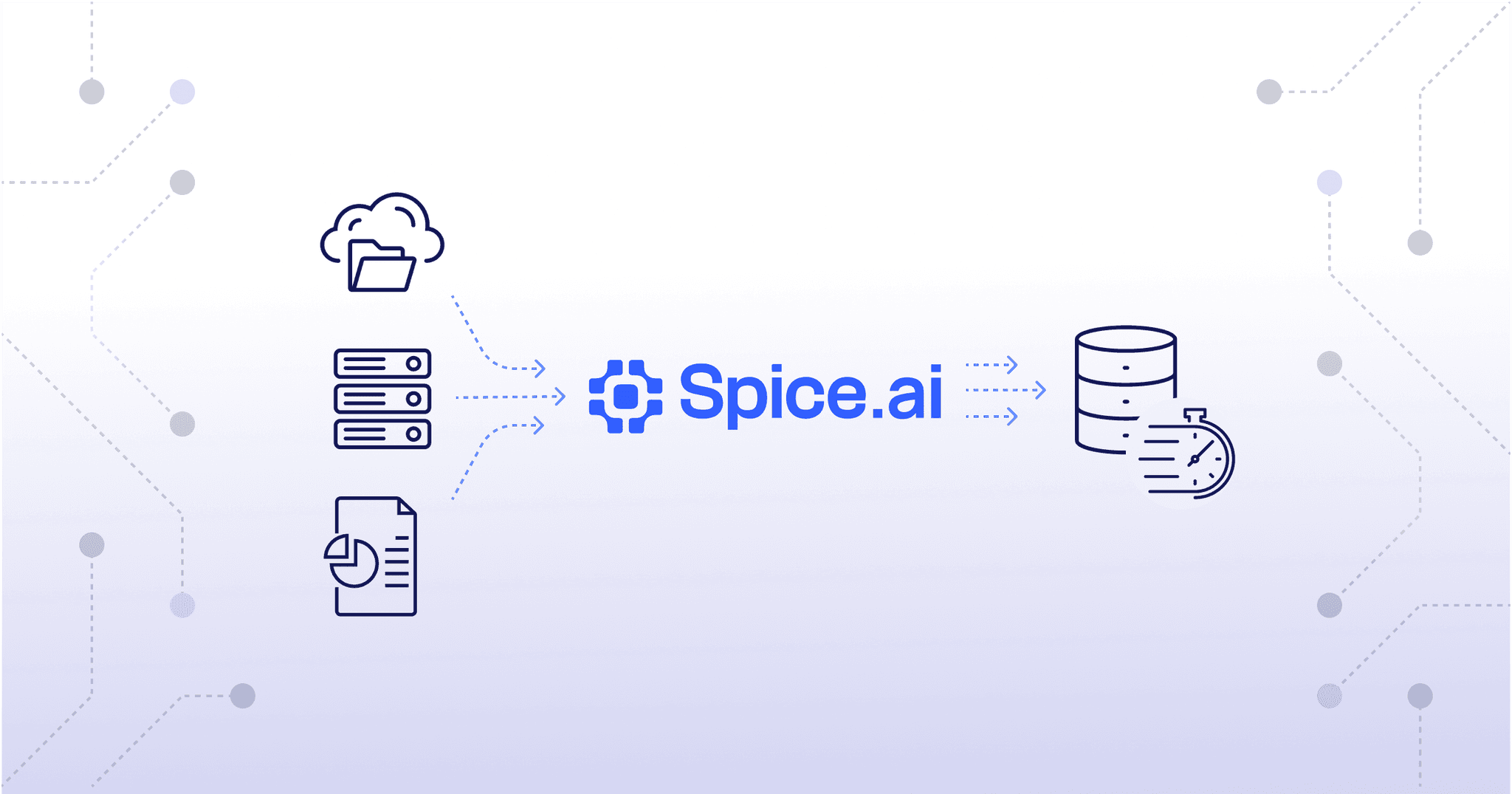
Getting Started with Spice.ai SQL Query Federation & Acceleration
How to use Spice to federate and accelerate queries across operational and analytical systems with zero ETL.
See Spice in action
Get a guided walkthrough of how development teams use Spice to query, accelerate, and integrate AI for mission-critical workloads.
Get a demo