Comparing Data Federation Tools for AI Agents
AI agents need fresh, governed access to data across APIs, databases, and warehouses. This guide compares data federation tool categories and helps you choose based on workload requirements.
Distributed SQL engines, data virtualization platforms, API gateway and orchestration stacks, and sidecar runtimes each show their design center and where an agent's query runs. A closing line lists the six criteria that apply to all four.
AI agents are creating a new access pattern for enterprise data. Instead of a dashboard issuing one predictable query every few minutes, agents run many small reads, branch into follow-up queries, and combine data from multiple systems inside one reasoning loop. That shift changes how teams evaluate federation tools.
This page compares major data federation tool categories used with AI agents, then provides a decision framework for selecting an approach. The goal is not to declare a universal winner. Different architectures optimize for different constraints.
Why AI Agents Change Federation Requirements
Traditional data integration decisions focused on BI reporting. AI agent workloads add requirements that are less common in dashboard-centric systems.
High query fan-out per user request
A single user prompt can trigger several tool calls. One agent response may need customer context from PostgreSQL, entitlement data from a SaaS API, and historical trends from a warehouse. Federation tools for agents need predictable multi-source behavior under bursty loads.
Tighter latency budgets
Agent response quality drops when retrieval is slow. A delay of even one or two seconds per tool call can cascade into poor interactive performance. This makes query planning efficiency, local acceleration, and source pushdown more important than in batch analytics.
Policy and tenancy boundaries
Many teams now run multiple agents with different scopes, roles, and trust levels. Federation layers must enforce row-level and source-level controls so one misconfigured agent cannot access another team's data. If you deploy through an MCP server gateway, this policy boundary becomes part of the runtime control plane.
Freshness over snapshot consistency
For many agent tasks, current operational state matters more than strict historical consistency. For example, support and operations agents care about what changed in the last minute, not only what landed in an hourly ETL batch.
Evaluation Criteria
Use the following dimensions to evaluate federation tools for AI agent workloads.
1. Source coverage and protocol flexibility
Check whether the tool can query your required source mix: OLTP databases, analytical warehouses, object storage, and HTTP APIs. AI agents often need all four. Broad connector support reduces custom adapter code and lowers long-term maintenance.
2. Pushdown and execution model
The best federation systems push filters and aggregations to source systems, then merge only reduced result sets. Poor pushdown behavior increases network transfer and latency. Ask for concrete evidence: explain plans, query traces, and benchmark methodology.
3. Freshness and acceleration options
Some tools focus on in-place query execution only. Others support local acceleration layers refreshed on a schedule or via change data capture. For agent workloads, acceleration is often the difference between acceptable and unacceptable latency.
4. Governance and access controls
Review authentication, authorization, and audit capabilities. Agent architectures usually need service identities, scoped credentials, and tenant-aware policies. Fine-grained controls are important when multiple agent services share the same federation layer.
5. Operational overhead
Compare deployment complexity, scaling model, failure domains, and observability. A tool with strong query performance but high operational burden may not fit small platform teams.
6. Cost model
Federation cost is not just license price. It includes duplicated storage, source query egress, cache refresh cost, and operational labor. Evaluate total cost of ownership over 12 to 24 months.
Tool Categories and Tradeoffs
Rather than comparing individual vendors in isolation, start with tool categories. This keeps the decision objective and maps better to architecture requirements.
Distributed SQL engines
Examples include open engines commonly used for federated querying across data lakes and warehouses.
Strengths:
- Mature SQL support for analytical workloads
- Strong ecosystem integration in data engineering teams
- Good fit for large scans and scheduled analytics
Limitations for agents:
- Can require substantial platform engineering to enforce per-agent isolation
- API and operational integration for agent workflows may need additional layers
- Interactive latency depends heavily on tuning and source behavior
Data virtualization platforms
These tools typically provide semantic layers, governance features, and broad enterprise connector coverage.
Strengths:
- Strong governance and policy administration
- Centralized metadata management
- Useful in organizations with strict cross-domain data controls
Limitations for agents:
- Can add complexity and licensing cost
- Performance characteristics vary by workload and pushdown quality
- Developer workflows may feel heavier for rapid AI iteration
API gateway plus query orchestration stacks
Some teams combine API gateways, custom service layers, and query orchestration components to provide agent-facing data access.
Strengths:
- Precise control over endpoint behavior
- Can align with existing service architecture patterns
- Easier to embed business-specific policies in code
Limitations for agents:
- High custom development and maintenance burden
- Harder to maintain consistent SQL semantics across sources
- Risk of duplicated logic across teams
Embedded or sidecar federation runtimes
These runtimes are deployed close to the application or agent service as a sidecar or lightweight microservice.
Strengths:
- Low network latency due to local execution path
- Natural isolation boundary per agent or per service
- Faster onboarding for new sources in application teams
Limitations for agents:
- Requires clear multi-instance operations model
- Fleet-wide observability and policy consistency need deliberate design
- Resource planning is important at higher scale
Comparison Table for AI Agent Use Cases
The table below summarizes typical behavior by category. Actual results depend on implementation and tuning.
| Dimension | Distributed SQL engines | Data virtualization platforms | API gateway plus orchestration | Embedded or sidecar federation |
|---|---|---|---|---|
| Primary design center | Analytical federation | Governed enterprise access | Service-level composition | App-local low-latency access |
| Typical latency profile | Medium to high without acceleration | Medium, depends on pushdown | Variable, depends on custom code | Low to medium with local acceleration |
| Source and API flexibility | High for SQL sources | High across enterprise connectors | High, but mostly custom | High when connector coverage is broad |
| Governance depth | Medium, often add-ons | High | Medium to high, code-driven | Medium to high, runtime-dependent |
| Per-agent isolation model | Needs extra architecture | Usually centralized | Custom by design | Natural fit with per-agent deployment |
| Operational complexity | Medium to high | Medium to high | High | Low to medium |
| Time to first production use | Medium | Medium | Slow for new teams | Fast to medium |
| Best fit | Centralized analytics teams | Large regulated organizations | Teams with strong platform engineering | Product teams building agentic apps |
Decision Framework
Use this sequence to select the right approach for your environment.
Step 1: Define latency and freshness SLOs
If your target is sub-second retrieval with minute-level freshness, prioritize architectures with local acceleration and efficient pushdown. If your target is minute-level latency for internal analysis, centralized federation may be sufficient.
Step 2: Define isolation boundaries
If each agent needs independent failure and permission boundaries, sidecar or per-service federation patterns are easier to reason about. If central governance is the top priority, virtualization platforms can simplify policy administration.
Step 3: Measure source load tolerance
Estimate incremental query pressure on source systems from agent traffic. If sources are sensitive to read amplification, favor solutions that support refreshable local acceleration to reduce repeated source hits.
Step 4: Score operational capacity
Be realistic about team size and on-call ownership. Highly customized orchestration stacks offer flexibility but increase maintenance load. Standardized federation runtimes can lower operational cost.
Step 5: Validate with production-like tests
Run a representative benchmark with real schemas, realistic prompt-driven query patterns, and policy checks. Include failover cases and degraded source behavior. Treat synthetic benchmarks as directional only.
Additional Requirements for Enterprise Deployments
Large organizations apply the criteria above and add four more. These rarely decide a prototype and often decide a rollout.
Residency and regional execution
Data that cannot leave a region constrains where queries run. Confirm the platform executes within a region rather than pulling rows to a central engine first. Pushdown reduces how much data crosses a regional boundary, and it cannot remove the crossing for a join whose inputs sit in different regions. One side still reaches the join executor. Where a policy forbids that crossing entirely, the query must be split or the data must be co-located.
Identity integration
Agent and application identities must map to the identity provider the organization already runs. A platform with its own separate user directory creates a second place to deprovision an employee, which audits find.
Chargeback and cost attribution
When many teams share a federation layer, someone must attribute cost. Look for per-workload query accounting. Without it, the platform bill arrives as one number that no team accepts.
Vendor and license risk
Assess what happens if the vendor changes direction. Open-source cores, open table formats, and standard interfaces such as SQL and Arrow Flight limit the exposure. This is a procurement question, and it usually arrives late in an evaluation.
Zero-ETL Platform Categories Compared
Many federation platforms market themselves as zero-ETL. The label covers three different mechanisms, and they behave differently. Any of them can be self-operated or bought as a managed service, so the operating model is a separate question from the mechanism. See zero-ETL for the underlying definitions.
| Mechanism | What it does | Data movement | Freshness | Main tradeoff |
|---|---|---|---|---|
| Query in place | Reads every source at query time | None | Live | Source systems absorb the read load |
| Snapshot plus change stream | Loads once, then applies committed changes | Incremental after the first load | Seconds | A copy to store and operate |
| Scheduled copy | Reloads tables on an interval | Full or partitioned tables | The interval | A pipeline to own and monitor |
Only the first mechanism moves no data. The second bounds the staleness without a scheduled job, and it still keeps a copy. Managed zero-ETL services usually implement the second mechanism, so judge them on freshness and copy location rather than on the label.
Advanced Topics
Per-agent blast radius design
Shared federation clusters can be efficient, but they also couple unrelated agent workloads. Per-agent or per-service deployment reduces blast radius by isolating faults and policy mistakes. This matters for enterprise environments where one agent may handle sensitive workloads while another runs lower-risk automation.
Hybrid acceleration strategies
Not every dataset needs the same acceleration policy. A practical approach is tiered acceleration: keep fast-changing operational tables on short refresh intervals, while less volatile reference datasets use longer intervals. This balances source load, freshness, and compute cost.
Observability for agent retrieval loops
Agent retrieval should be observable end to end. Useful signals include query latency percentiles, source pushdown ratios, cache hit rate, source error distribution, and policy-denied access attempts. Without this telemetry, teams struggle to distinguish model issues from data access bottlenecks.
Data Federation for AI Agents with Spice
Spice combines federated SQL querying with local acceleration so teams can serve agent workloads with lower latency and controlled freshness windows. It connects to databases, warehouses, object stores, and APIs across integrations, then executes through a unified SQL surface.
For teams adopting an agent architecture, Spice can run as a lightweight service near agent runtimes and expose governed access paths through an MCP server gateway. This model supports tighter isolation and more predictable operational boundaries while preserving broad source access.
The practical outcome is a hybrid path: query in place where needed, accelerate where latency matters, and keep central ETL only for workloads that require long-horizon historical processing.
To evaluate this hybrid path on sample data, start with the Federated SQL Query recipe in the Spice cookbook. The Spice as MCP Server recipe then connects an MCP client to accelerated GitHub datasets and proxied GitHub tools.
For deployment planning and budget alignment, review Spice Cloud pricing.
Data Federation Tools for AI Agents FAQ
Start with latency and freshness requirements. Agent response quality depends on retrieval speed and current data. After that, evaluate governance, source coverage, and operational overhead. Teams often over-index on connector count and under-index on execution behavior under real load.
Yes, but workload profiles differ. BI workloads are often heavier and scheduled. Agent workloads are usually bursty and interactive. A single platform can serve both when it supports efficient pushdown, acceleration, and policy controls tuned per workload class.
No. Per-agent deployment is useful when strict isolation and blast-radius control are priorities. Shared deployments can work when governance is strong and workloads are compatible. The right model depends on your risk profile, team structure, and multi-tenant requirements.
Use production-like query traces driven by realistic prompts, not only synthetic SQL benchmarks. Include cross-source joins, policy checks, source timeouts, and retry behavior. Measure tail latency, cache hit rates, and source load impact in addition to average response time.
Most teams need both. Federation is strong for real-time, cross-source access. ETL remains useful for heavy historical analytics, compliance archives, and long-range reporting. A hybrid architecture usually provides the best balance of freshness, performance, and cost.
Learn more about federation and agent data access
Documentation and technical guides for evaluating federation architectures and operating them in production.
Query Federation Docs
Learn how federated SQL query planning, pushdown, and acceleration work in Spice.

Getting Started with Spice.ai SQL Query Federation & Acceleration
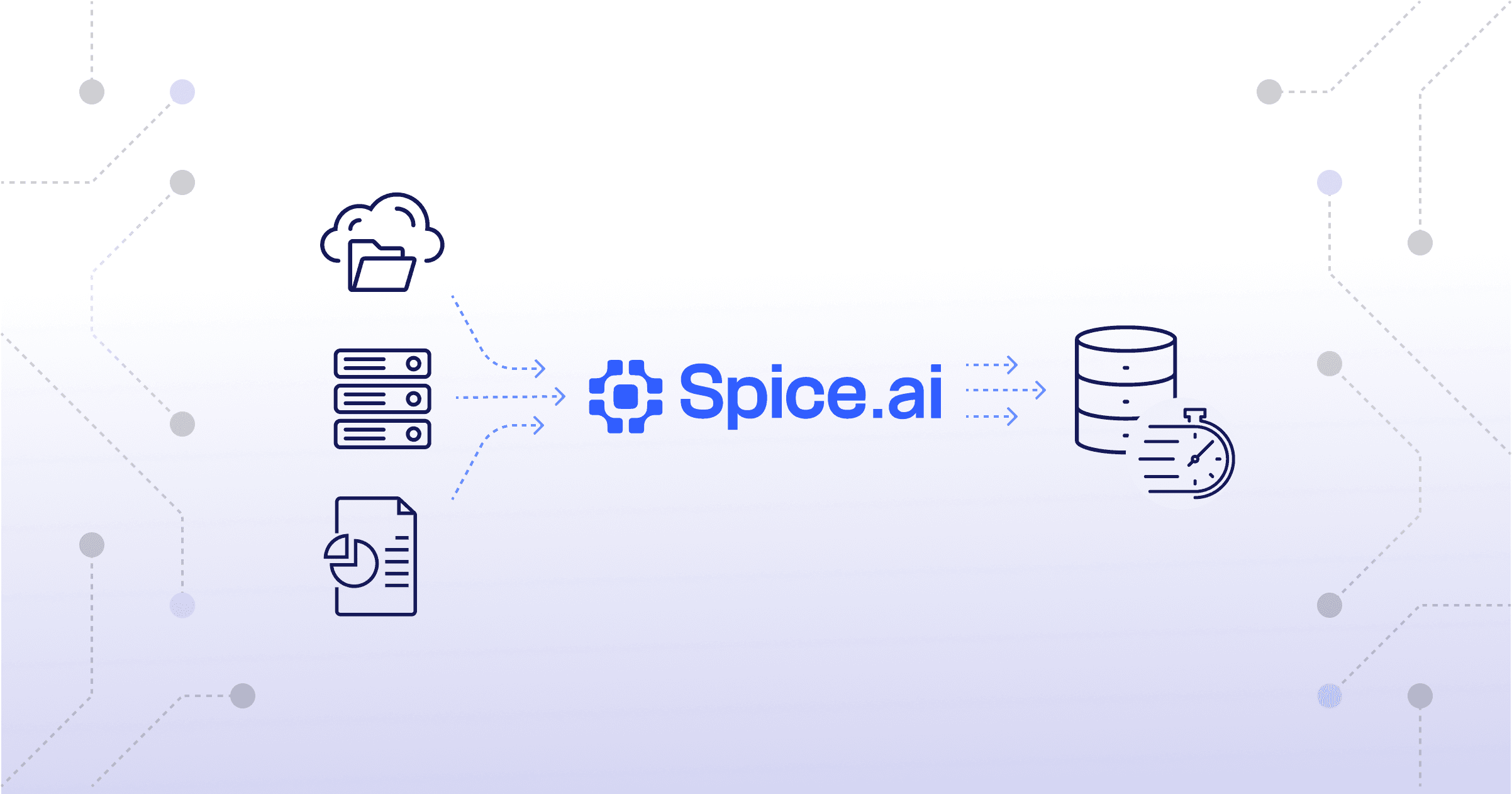
Learn how to use Spice.ai to federate and accelerate queries across operational and analytical systems with zero ETL.
How we use Apache DataFusion at Spice AI
A technical overview of how Spice extends Apache DataFusion with custom table providers, optimizer rules, and UDFs to power federated SQL, search, and AI inference.
See Spice in action
Walk through your use case with an engineer and see how Spice handles federation, acceleration, and AI integration for production workloads.
Talk to an engineer (opens in a new tab)