RAG vs Fine-Tuning
Retrieval-augmented generation and fine-tuning are the two primary approaches to customizing LLM behavior with domain-specific knowledge. Each solves a different problem, and most production systems benefit from understanding when to apply each.
RAG adds retrieved documents to the prompt at query time and leaves the model unchanged. Fine-tuning changes the model's weights with a training run. New information points to RAG, new behavior to fine-tuning, and many systems use both.
When teams build AI applications that need domain-specific knowledge, they face a fundamental question: should the model retrieve relevant data at query time, or should that knowledge be trained directly into the model's weights? This is the core distinction between retrieval-augmented generation (RAG) and fine-tuning.
Neither approach is universally better. RAG excels at injecting current, factual information into model responses. Fine-tuning excels at shaping how a model reasons, responds, and follows domain-specific patterns. Understanding the tradeoffs between them (and knowing when to combine them) is essential for building production AI systems that are accurate, maintainable, and cost-effective.
What is RAG?
Retrieval-augmented generation is an architecture pattern that retrieves relevant data from external sources at inference time and includes it in the LLM's prompt as context. Rather than relying solely on knowledge stored in model weights, the LLM generates responses grounded in specific, current information.
A RAG pipeline operates in three stages:
- Indexing: Source data (documents, database records, knowledge base articles) is chunked and converted into embeddings: dense vector representations stored in a searchable index.
- Retrieval: When a user query arrives, the system searches the index using vector similarity, keyword matching, or hybrid search to find the most relevant chunks.
- Generation: The retrieved chunks are injected into the LLM prompt as context, and the model generates a response grounded in that specific data.
RAG does not modify the model itself. The same base model can serve different use cases simply by changing which data sources it retrieves from. This makes RAG highly flexible and straightforward to update: new knowledge becomes available as soon as it is indexed.
What is Fine-Tuning?
Fine-tuning modifies a pre-trained model's weights by continuing its training on a domain-specific dataset. This permanently embeds knowledge, behavior patterns, and stylistic preferences into the model. After fine-tuning, the model "knows" the new information in the same way it knows its original training data: through learned parameters rather than external context.
The fine-tuning process typically involves:
- Data preparation: Curating a dataset of input-output pairs that demonstrate the desired behavior (e.g., question-answer pairs in your domain, examples of the target writing style, or task-specific demonstrations).
- Training: Running additional training passes over this data, adjusting the model's weights to minimize prediction error on the new examples. Techniques like LoRA (Low-Rank Adaptation) reduce the computational cost by training only a small subset of parameters.
- Evaluation: Testing the fine-tuned model against held-out examples to measure improvement and check for regressions in general capability.
Fine-tuning changes the model permanently. The resulting model carries its new knowledge and behaviors without needing any external data at inference time.
Key Differences
The following table summarizes the core tradeoffs between RAG and fine-tuning across the dimensions that matter most for production systems.
| Dimension | RAG | Fine-Tuning |
|---|---|---|
| Knowledge source | External data retrieved at query time | Embedded in model weights during training |
| Data freshness | Real-time: updates available as soon as data is indexed | Static: requires retraining to incorporate new information |
| Setup cost | Moderate: requires retrieval infrastructure (search index, embedding pipeline) | High: requires curated training data, GPU compute, and training expertise |
| Update cost | Low: re-index changed data | High: retrain the model on updated data |
| Inference latency | Higher: adds retrieval step before generation | Lower: no retrieval step required |
| Accuracy on factual queries | High: answers grounded in retrieved source data | Variable: depends on training data coverage |
| Hallucination risk | Lower for covered topics: model has source context | Higher for edge cases outside training distribution |
| Behavioral customization | Limited: model behavior unchanged | Strong: can reshape tone, style, and reasoning patterns |
| Context window dependency | Yes: bounded by how much context the model can process | No: knowledge is in weights, not context |
| Auditability | High: can trace answers to specific source documents | Low: knowledge is distributed across model parameters |
When to Use RAG
RAG is the better choice when your application needs to work with data that changes frequently, when auditability and source attribution matter, or when you need to query across multiple data sources without retraining a model.
Use RAG when:
- Data changes frequently. Product documentation, pricing, policies, inventory, and support articles change regularly. RAG reflects these changes as soon as the index is updated, without retraining.
- Source attribution is required. Compliance, legal, and customer-facing applications often need to cite the specific documents that informed a response. RAG naturally supports this because the retrieved chunks are available alongside the generated answer.
- You query multiple or heterogeneous data sources. Enterprise data lives across databases, wikis, APIs, and file systems. RAG can retrieve from all of these sources through a unified search layer.
- You need to control costs. RAG avoids the GPU compute and training pipeline required for fine-tuning. Adding new knowledge is a data indexing operation, not a model training operation.
- Accuracy on factual questions is critical. Grounding responses in retrieved source data significantly reduces hallucinations compared to relying solely on model weights.
When to Use Fine-Tuning
Fine-tuning is the better choice when you need to change how a model behaves, not just what information it has access to. It is particularly effective for shaping output format, tone, reasoning style, and domain-specific patterns.
Use fine-tuning when:
- You need a specific output format or style. If your application requires responses in a particular structure (JSON, specific templates, clinical language, legal prose), fine-tuning teaches the model to consistently produce that format.
- You need domain-specific reasoning. Medical diagnosis, legal analysis, and financial modeling involve reasoning patterns that general-purpose models may not handle well. Fine-tuning on expert examples teaches the model how to reason in your domain.
- Latency is critical. Fine-tuning eliminates the retrieval step, reducing inference latency. For real-time applications where every millisecond matters, this can be significant.
- The knowledge is static and well-defined. If your domain knowledge rarely changes (e.g., established medical terminology, programming language syntax, mathematical concepts), fine-tuning embeds it directly without needing retrieval infrastructure.
- You want to reduce prompt size. Fine-tuned models carry knowledge in their weights, so you don't need to include large amounts of context in each prompt. This reduces token costs and avoids context window limitations.
Decision Framework
Use the following framework to determine which approach (or combination) fits your use case.
Step 1: Identify the Problem Type
Ask: "Am I trying to give the model new information, or change how it behaves?"
- New information (facts, documents, records) --> RAG
- New behavior (style, format, reasoning patterns) --> Fine-tuning
- Both --> Combine RAG and fine-tuning
Step 2: Assess Data Volatility
Ask: "How often does the underlying data change?"
- Daily or more frequently --> RAG (retraining at this cadence is impractical)
- Monthly to quarterly --> Either approach works; consider other factors
- Rarely or never --> Fine-tuning is viable
Step 3: Evaluate Auditability Requirements
Ask: "Do I need to trace responses back to specific source documents?"
- Yes --> RAG (source attribution is a built-in capability)
- No --> Either approach works
Step 4: Consider Infrastructure and Cost
Ask: "What infrastructure and expertise do I have available?"
- Strong data infrastructure, limited ML training expertise --> RAG
- Strong ML training expertise, stable training data --> Fine-tuning
- Both --> Combine approaches
Step 5: Plan for the Combination
In many production systems, the answer is not RAG or fine-tuning, but RAG and fine-tuning. A common pattern is:
- Fine-tune the model for domain-specific behavior: output format, terminology, reasoning style, and tone
- Use RAG to inject current, factual knowledge at query time: product data, customer records, policy documents, real-time metrics
This combination gives you a model that both behaves correctly for your domain and knows the latest information, without requiring retraining every time your data changes.
Advanced Topics
RAG with Structured Data
Most RAG tutorials focus on unstructured text: documents, articles, knowledge bases. But enterprise data is frequently structured: relational databases, data warehouses, operational systems. Structured data RAG retrieves from SQL-queryable sources rather than (or in addition to) vector indexes.
Instead of embedding and searching document chunks, structured data RAG translates natural language queries into SQL, executes them against connected databases, and includes the results as context for the LLM. This approach is particularly effective for questions involving aggregations, filtering, joins, and exact lookups (operations where vector similarity search performs poorly).
Hybrid SQL search combines both paradigms: vector search for semantic retrieval over unstructured content and SQL queries for precise retrieval from structured data. This is critical in enterprise environments where the answer to a question may require joining product documentation (unstructured) with pricing tables (structured) and customer records (structured).
Parameter-Efficient Fine-Tuning
Full fine-tuning updates all of a model's parameters, which is computationally expensive and risks catastrophic forgetting: the model loses general capabilities as it overfits to the new data. Parameter-efficient fine-tuning (PEFT) methods address this by training only a small fraction of parameters.
LoRA (Low-Rank Adaptation) is the most widely adopted PEFT method. It freezes the original model weights and injects small, trainable rank-decomposition matrices into each layer. Instead of updating millions or billions of parameters, LoRA trains thousands to millions, reducing GPU memory requirements by 60-80% while achieving comparable quality to full fine-tuning on most tasks.
QLoRA combines LoRA with quantization, loading the base model in 4-bit precision and training only the LoRA adapters in full precision. This enables fine-tuning large models (7B-70B parameters) on a single consumer GPU, a significant reduction in the infrastructure barrier to fine-tuning.
These techniques make fine-tuning more accessible, but the fundamental tradeoffs remain: fine-tuning still requires curated training data, evaluation infrastructure, and retraining when the domain evolves.
Combining RAG and Fine-Tuning in Production
The most sophisticated production systems use fine-tuning and RAG together, but integrating them introduces its own challenges. A fine-tuned model may have learned patterns during training that conflict with retrieved context at inference time. For example, if the model was fine-tuned on outdated pricing information and the RAG system retrieves current pricing, the model must correctly prioritize the retrieved context over its trained knowledge.
Techniques to manage this include instruction tuning the model to explicitly prefer retrieved context over internal knowledge, using system prompts that reinforce context-grounding behavior, and evaluating with adversarial examples where retrieved context contradicts trained knowledge.
Monitoring is essential in combined systems. Track how often the model's responses align with retrieved context versus its trained knowledge. A drift toward trained knowledge (ignoring retrieved context) is a signal that the fine-tuning is overriding RAG, a common failure mode that degrades accuracy as source data diverges from training data.
How Spice Powers RAG Pipelines
Spice provides the data infrastructure layer that production RAG systems require: unified retrieval across structured and unstructured data, with the performance characteristics needed for real-time AI applications.
Hybrid SQL search combines vector similarity, full-text keyword matching, and structured SQL queries in a single interface. Rather than managing separate vector databases, search engines, and relational databases, Spice executes all three retrieval modes in one query. This is particularly important for enterprise RAG where answers depend on both unstructured documents and structured operational data.
LLM inference runs embedding models and generation models alongside data queries in the same runtime. Embedding generation, retrieval, and response generation happen within a single system, eliminating the network hops and orchestration complexity of stitching together separate embedding services, vector databases, and LLM APIs.
Data federation and acceleration connect RAG pipelines to data wherever it lives. Spice federates queries across 40+ data sources (databases, warehouses, APIs, and file systems) so the retrieval layer has access to all relevant enterprise data without complex ETL pipelines. Query acceleration caches frequently accessed data locally for low-latency retrieval, a critical requirement when RAG queries must complete in hundreds of milliseconds.
Real-time data freshness keeps indexes current as source data changes. Through change data capture and incremental re-indexing, Spice ensures that the retrieval layer reflects the latest state of your data, addressing one of the most common failure modes in production RAG systems where stale indexes produce outdated answers.
For an index that stays current without retraining, see the Hybrid Search and Real-Time Indexing recipe in the Spice cookbook. New Bluesky posts become searchable after each refresh, and a chat model answers questions about them.
For teams evaluating whether to use RAG, fine-tuning, or both, Spice provides the retrieval infrastructure that makes RAG practical at production scale, letting you focus on the AI application logic rather than the underlying data plumbing.
RAG vs Fine-Tuning FAQ
Yes, and many production systems do. A common pattern is to fine-tune the model for domain-specific behavior, such as output format, reasoning style, and terminology. RAG then adds current factual knowledge at query time. This gives you a model that both behaves correctly for your domain and has access to the latest information without retraining.
RAG is typically more cost-effective for knowledge-intensive applications. The primary cost is retrieval infrastructure (search indexes, embedding pipelines), which scales predictably. Fine-tuning requires GPU compute for training, curated datasets, and retraining whenever domain knowledge changes. However, fine-tuning can reduce per-query costs by eliminating the retrieval step and reducing prompt token counts.
Yes. Although most RAG implementations focus on unstructured text, production RAG systems increasingly retrieve from structured data sources using SQL queries alongside vector search. Spice runs hybrid SQL search that combines vector similarity, keyword matching, and structured SQL retrieval in a single query. This grounds LLM responses in both documents and database records.
Fine-tuned models hallucinate when queries fall outside their training distribution: they generate plausible-sounding but incorrect responses. Detection requires evaluation datasets with known correct answers, human review of edge cases, and monitoring confidence signals. RAG reduces this risk by grounding responses in retrieved source data, making it easier to verify accuracy and trace answers to specific documents.
RAG adds a retrieval step before generation, typically adding 50-200ms depending on index size, search complexity, and infrastructure. Fine-tuned models skip this step, generating responses directly from weights. For latency-critical applications (real-time chat, autocomplete), this difference matters. However, RAG latency can be minimized with query acceleration, local caching, and optimized search infrastructure.
Learn more about RAG and fine-tuning
Technical guides and blog posts on building production RAG systems with hybrid search, LLM inference, and real-time data.
Hybrid Search Docs
Learn how Spice provides semantic, full-text, and hybrid search capabilities for RAG applications.

AWS Workshop: Federated Queries and Hybrid Search with Spice.ai
A new AWS catalog workshop for deploying Spice as a data and AI substrate for federated queries, hybrid search, and LLM inference.
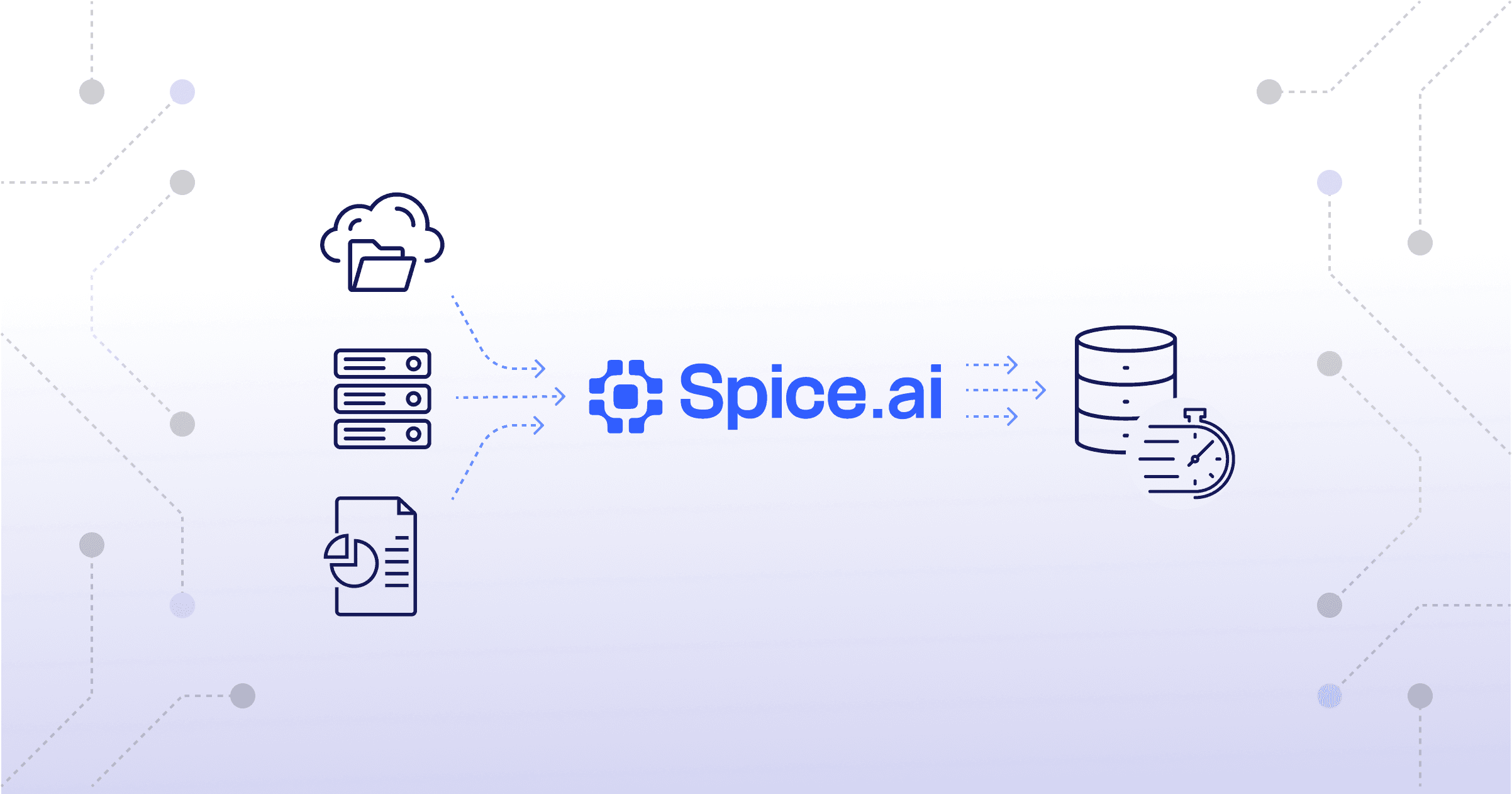
Getting Started with Spice.ai SQL Query Federation & Acceleration
Learn how to use Spice.ai to federate and accelerate queries across operational and analytical systems with zero ETL.
See Spice in action
Walk through your use case with an engineer and see how Spice handles federation, acceleration, and AI integration for production workloads.
Talk to an engineer (opens in a new tab)