Data Virtualization vs Data Replication
Data virtualization and data replication are two foundational approaches to making data available across systems. Each involves distinct tradeoffs in freshness, performance, cost, and operational complexity, and most production architectures benefit from combining both.
Replication copies the few hot datasets that get most of the reads into a replica, so those reads stay local. A rare read of the long tail goes through a virtual layer to the data in place, and most platforms use both.
When an application, dashboard, or AI model needs data from multiple systems (transactional databases, cloud warehouses, object stores, SaaS APIs), engineering teams face a fundamental design decision: query the data where it lives, or copy it somewhere faster and closer.
Data virtualization takes the first approach. A virtualization layer presents a unified SQL interface across sources, translating and routing queries to each system at runtime. The data never moves: only the query results are returned to the consumer.
Data replication takes the second approach. Data is physically copied from source systems into a target system: a data warehouse, a data lake, or a local acceleration engine. Consumers query the replica, which is optimized for their specific access patterns.
Neither approach is inherently better. Each excels in different scenarios, and most production data architectures use both in combination. This guide explains the key differences, walks through a decision framework, and shows how modern platforms unify both patterns.
How Data Virtualization Works
Data virtualization provides a query abstraction layer over distributed data sources. Instead of moving data, it moves queries. The virtualization engine connects to each source system, translates the incoming SQL into the native dialect of each source, executes queries in parallel, and merges results before returning them to the application.
Key characteristics of virtualization:
- No data movement: Data stays in its source systems. There is no duplication, no storage cost for copies, and no synchronization to maintain.
- Always fresh: Every query reads from the live source, so results always reflect the current state of each system.
- Rapid onboarding: New data sources become queryable immediately after connecting; no schema design, migration scripts, or pipeline orchestration required.
- Source-dependent performance: Query latency depends on source system performance, network distance, and query complexity. Remote sources and complex cross-source joins can be slow.
Virtualization engines optimize performance through predicate pushdown (pushing filters to the source so only matching rows are transferred), aggregation pushdown (computing sums and counts at the source), and query parallelization (executing requests to independent sources concurrently). These optimizations narrow the performance gap with co-located data, but they cannot eliminate the network round-trip entirely.
How Data Replication Works
Data replication physically copies data from source systems into a target system optimized for the consumer's workload. The replication process can be batch-oriented (traditional ETL that runs on a schedule) or continuous (streaming pipelines powered by change data capture).
Key characteristics of replication:
- Co-located data: Queries run against local, pre-optimized copies. Cross-table joins, aggregations, and scans are fast because all data is in one place.
- Predictable performance: Latency is determined by the target system, not the source. Query times are consistent regardless of source load or network conditions.
- Storage and pipeline costs: Maintaining replicas requires storage for the copies and engineering effort to keep them synchronized. Schema changes at the source can break pipelines.
- Staleness window: Unless replication is continuous, the replica always lags behind the source by at least the replication interval.
Modern replication approaches have narrowed the freshness gap significantly. CDC-based replication can keep replicas within seconds of the source, and data acceleration engines maintain queryable local copies that refresh automatically, eliminating much of the traditional ETL burden.
Key Differences: Side-by-Side Comparison
The following table summarizes the core tradeoffs between virtualization and replication across the dimensions that matter most in production.
| Dimension | Data Virtualization | Data Replication |
|---|---|---|
| Data freshness | Real-time: always reads live source data | Depends on replication method: batch ETL (minutes to hours), CDC (seconds) |
| Query performance | Source-dependent; network round-trip for every query | Fast and predictable; queries run against local, optimized copies |
| Storage cost | No additional storage: data stays at source | Requires storage for each replica; cost scales with data volume |
| Operational complexity | Low setup; no pipelines to maintain | Pipelines must be built, monitored, and maintained over time |
| Schema change handling | Transparent: connector reads current schema at query time | Pipeline breakage risk; schema changes must be propagated |
| Cross-source joins | Handled at query time; performance depends on data volume | Fast if all data is co-located in the target system |
| Source system load | Every consumer query hits the source system | Source is queried only during replication; consumer queries don't touch it |
| Offline resilience | Queries fail if a source is unavailable | Queries succeed against the replica even if the source is down |
| Best for | Real-time access, ad-hoc exploration, rapid prototyping | High-throughput analytics, latency-sensitive applications, offline access |
Neither column is uniformly better. The right choice depends on the specific workload, freshness requirements, and performance constraints.
Decision Framework
Choosing between virtualization and replication (or determining the right mix of both) requires evaluating four key factors.
1. Freshness Requirements
If the workload requires data that is always current (real-time dashboards, fraud detection, operational monitoring), virtualization provides guaranteed freshness without pipeline delays. If the workload tolerates minutes or hours of staleness (historical analytics, monthly reporting, compliance archives), replication with batch ETL is simpler and more cost-effective.
For workloads that need both freshness and speed (sub-second queries on near-real-time data), the answer is often CDC-based replication, where a local acceleration cache is kept current through continuous change streaming.
2. Query Performance Needs
If queries must return in milliseconds and the source systems are remote, slow, or expensive to query, replication is the right pattern. Pre-computing and co-locating data ensures consistent, fast query times regardless of source conditions.
If query latency in the hundreds-of-milliseconds-to-seconds range is acceptable, virtualization avoids the overhead of maintaining replicas. Query pushdown optimizations can make virtualized queries surprisingly fast, especially for simple lookups and filtered reads.
3. Data Volume and Breadth
For workloads that access a small number of well-defined datasets repeatedly, replication is efficient: the cost of maintaining copies is justified by the performance benefit. For workloads that need broad, ad-hoc access across many datasets (some of which may be queried only once), virtualization avoids the waste of replicating data that may never be read.
In practice, most organizations have a mix: a small set of "hot" datasets that are queried constantly, and a long tail of datasets accessed infrequently. The hot datasets are candidates for replication; the long tail is best served by virtualization.
4. Operational Capacity
Replication requires ongoing engineering investment: pipeline monitoring, failure handling, schema evolution, storage management, and cost optimization. Teams with mature data engineering practices and existing pipeline infrastructure can absorb this cost. Teams that are small, moving fast, or focused on application development rather than data infrastructure may prefer the operational simplicity of virtualization.
Quick Reference
- Choose virtualization when freshness is non-negotiable, the dataset count is high, queries are infrequent or ad-hoc, and operational simplicity matters.
- Choose replication when query performance is critical, the workload is high-throughput, the dataset set is stable and well-defined, and offline resilience is needed.
- Choose both when different workloads have different requirements, which is the case for nearly every production data platform.
Advanced Topics
Consistency Models in Hybrid Architectures
When virtualization and replication coexist in the same platform, consistency becomes a design challenge. A query might touch both a virtualized dataset (live from the source) and a replicated dataset (potentially seconds behind). The results reflect two different points in time, which can produce subtle inconsistencies.
For example, an application joins a virtualized orders table with a replicated customers table. If a new customer places an order, the virtualized orders table shows the order immediately, but the replicated customers table might not yet contain the new customer record. The join produces a row with a null customer name, a temporal inconsistency.
Handling this requires either accepting eventual consistency (appropriate for most analytical and AI workloads), designing queries to tolerate missing joins (using LEFT JOINs instead of INNER JOINs for cross-boundary queries), or ensuring that related datasets use the same access pattern (both virtualized or both replicated). Production platforms that support transparent query routing (automatically choosing between virtualized and accelerated paths) must document their consistency guarantees so application developers can make informed decisions.
Materialization Strategies for Cost Optimization
The cost profile of replication depends heavily on what is replicated, how often, and where. Full-table replication of a multi-terabyte fact table is expensive in both storage and refresh compute. Partial materialization strategies reduce this cost without sacrificing query coverage.
Time-windowed materialization replicates only recent data: for example, the last 90 days of transactions. Queries within the window are served from the fast local copy; queries for older data are federated to the source warehouse or data lake. This pattern works well for operational data lakehouse architectures where recent data drives operational decisions and historical data supports periodic analysis.
Aggregation-based materialization replicates pre-computed aggregates rather than raw rows. Instead of replicating 100 million order line items, the acceleration layer materializes daily revenue by product category, a tiny fraction of the storage cost. This approach trades query flexibility for efficiency: only queries that match the pre-computed aggregations can be served from the replica.
Access-pattern-driven materialization monitors query logs to identify which datasets and columns are actually accessed, then replicates only that subset. If an application queries 5 columns out of a 200-column table, replicating only those 5 columns reduces storage by 97%. This strategy requires a feedback loop between the query engine and the replication layer, a capability found in modern data lake acceleration platforms.
Federation Pushdown Optimization
The performance gap between virtualization and replication narrows significantly when the virtualization engine can push more computation to the source. Beyond simple predicate pushdown, advanced engines support join pushdown (executing joins between two tables in the same source rather than fetching both and joining locally), limit pushdown (stopping source scans after enough rows are collected), and projection pushdown (requesting only the columns needed rather than full rows).
The effectiveness of pushdown depends on the source system's capabilities. A PostgreSQL source can handle complex pushed-down predicates, joins, and aggregations. An S3 source with Parquet files can handle predicate pushdown and projection pushdown but not joins. A REST API source may support no pushdown at all: every request returns full results that must be filtered locally. Understanding each connector's pushdown capabilities is essential for predicting virtualized query performance and deciding which datasets to replicate for better results.
How Spice Combines Both Approaches
Most comparisons of virtualization and replication present them as either/or choices. In practice, the strongest data architectures use both, and the challenge is combining them in a single, coherent platform rather than operating two separate systems.
Spice unifies data virtualization and replication in one runtime. The platform provides SQL federation across 40+ data connectors (databases, warehouses, object stores, and streaming systems) so any dataset is queryable immediately through a single SQL endpoint. This is the virtualization layer: no data movement, always-fresh results, instant onboarding.
For datasets that require faster performance, Spice adds data acceleration: local replication into in-memory (Apache Arrow) or on-disk (DuckDB) engines that serve queries in milliseconds. Acceleration is configured per dataset, so teams can selectively replicate only the datasets that benefit from it. The acceleration cache is kept fresh through change data capture or scheduled refresh, depending on the source.
The query router handles this transparently. When a query arrives, Spice checks whether the requested datasets are accelerated locally. If so, the query is served from the local engine. If not, it is federated to the remote source. Applications interact with a single SQL endpoint and do not need to know which datasets are virtualized and which are replicated.
This hybrid approach gives teams the operational simplicity of virtualization (no pipelines to build for initial access) with the performance of replication where it matters. A team can start by federating all data sources for immediate unified access, identify the hot datasets through query patterns, and then selectively accelerate those datasets without changing application queries. The operational data lakehouse, data lake accelerator, and real-time analytics use cases demonstrate this pattern in production, where Spice federates across the full data estate and accelerates the datasets that drive latency-sensitive applications and AI workloads.
The Dual-Dataset Registration recipe in the Spice cookbook runs both approaches on one S3 table. It queries the federated table at startup, then moves reads to an accelerated copy after the copy loads.
Data Virtualization vs Data Replication FAQ
Yes. Most production data architectures use both. Virtualization provides broad, real-time access across all data sources, while replication (or acceleration) delivers fast performance for frequently accessed datasets. Modern platforms like Spice unify both patterns in a single runtime with transparent query routing.
Choose virtualization when data freshness is critical or when you need ad-hoc access across many sources. It also fits when operational simplicity matters, or when you prototype and want to avoid building ETL pipelines. Virtualization is also preferred when storage costs for replicas would be prohibitive.
Choose replication when you need sub-second query latency or when workloads are high-throughput and predictable. It also fits when you need offline resilience, so queries succeed even if a source is down. Finally, choose it when the source system cannot handle the extra query load from virtualized access.
Not necessarily. Traditional batch ETL introduces hours of staleness, but modern replication using change data capture (CDC) keeps replicas within seconds of the source. CDC-based acceleration combines the performance benefits of replication with near-real-time freshness, effectively eliminating the staleness tradeoff for most workloads.
Spice provides both patterns in a single platform. All connected data sources are queryable immediately via SQL federation (virtualization). Teams can then selectively accelerate specific datasets into local in-memory or on-disk engines (replication) for faster performance. For operational databases, Spice can also maintain a full analytics replica kept fresh via change data capture. The query router transparently serves each query from the optimal path: no application changes required.
Learn more about data virtualization and replication
Guides and blog posts on querying, accelerating, and integrating data across distributed sources.
Query Federation Docs
Learn how Spice federates SQL queries across 40+ data sources and accelerates datasets locally for sub-second performance.
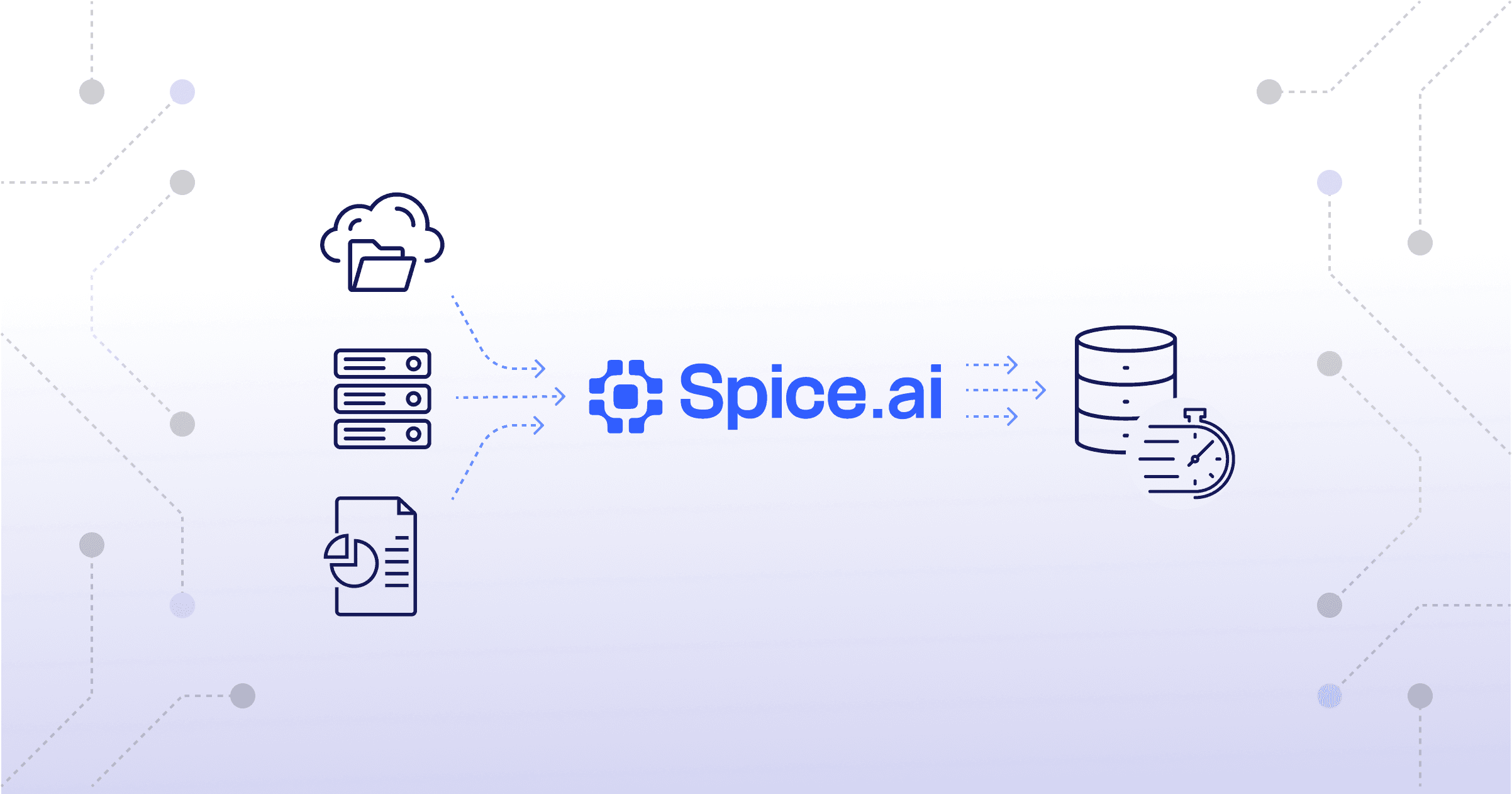
Getting Started with Spice.ai SQL Query Federation & Acceleration
Learn how to use Spice.ai to federate and accelerate queries across operational and analytical systems with zero ETL.
How we use Apache DataFusion at Spice AI
A technical overview of how Spice extends Apache DataFusion with custom table providers, optimizer rules, and UDFs to power federated SQL, search, and AI inference.
See Spice in action
Walk through your use case with an engineer and see how Spice handles federation, acceleration, and AI integration for production workloads.
Talk to an engineer (opens in a new tab)