What is Apache Arrow?
Apache Arrow is a cross-language development platform for in-memory columnar data. It defines a standardized memory format, libraries for zero-copy reads, and protocols for high-speed data transport, providing the foundation that modern analytical systems build on.
Without a shared format, every system boundary serializes a copy and parses it again. With Arrow, a library, another process and a remote client read the same columnar buffers through a pointer, shared memory and Arrow Flight.
Moving data between systems is one of the most expensive operations in modern data architectures. Every time data crosses a boundary (between a database and an application, between Python and Java, between a query engine and a visualization layer), it is typically serialized into a wire format, transmitted, and deserialized on the other side. This serialization-deserialization cycle can consume more time and compute than the actual analytical work.
Apache Arrow eliminates this overhead by defining a language-independent columnar memory format. When two systems both use Arrow, they share the same in-memory representation. Data moves between them with zero serialization: a pointer handoff, a shared memory region, or a network transfer of raw memory buffers. No parsing, no schema inference, no row-to-column conversion.
This is why Arrow has become the de facto standard for in-memory analytical data. It is used by query engines (Apache DataFusion, DuckDB, Velox), data science libraries (pandas, polars, R Arrow), data formats (Vortex, Parquet readers), and data transport layers (Flight SQL, ADBC), all sharing the same memory layout and able to exchange data without conversion.
The Columnar Memory Format
Arrow's core contribution is a specification for how columnar data is laid out in memory. This specification is precise enough that any implementation (in any language) produces byte-identical memory layouts for the same data.
Why Columnar?
In a row-oriented layout, each record's fields are stored contiguously: [name1, age1, score1, name2, age2, score2, ...]. This is efficient for transactional workloads that read or write entire records at a time.
In a columnar layout, each field is stored contiguously across all records: [name1, name2, ...], [age1, age2, ...], [score1, score2, ...]. This layout is efficient for analytical workloads that scan a subset of columns across many records: the common pattern in aggregations, filters, and joins.
Arrow uses a columnar layout because analytical workloads dominate its use cases. Scanning a single column means reading a contiguous block of memory, which maximizes CPU cache utilization and enables SIMD (Single Instruction, Multiple Data) vectorized operations.
Memory Layout Specification
The Arrow format defines how each data type is represented in memory:
- Primitive types (integers, floats, booleans) are stored as contiguous, aligned arrays of fixed-width values. An
int64column of 1,000 rows is exactly 8,000 bytes of contiguous memory. - Variable-length types (strings, binary) use an offsets buffer and a values buffer. The offsets buffer stores the start position of each value in the values buffer. This enables O(1) random access to any value.
- Nested types (structs, lists, maps) are composed from child arrays. A
List<Int32>column has an offsets array (marking where each list starts and ends) and a childInt32array (containing all values from all lists, concatenated). - Null handling uses a separate validity bitmap: one bit per value indicating whether it is null. This avoids sentinel values and keeps the data arrays dense.
All buffers are aligned to 64-byte boundaries, enabling efficient SIMD operations without alignment checks.
Record Batches
Arrow organizes data into record batches: collections of equal-length arrays with a shared schema. A record batch is the fundamental unit of data exchange in the Arrow ecosystem. It contains the column arrays, their lengths, and the schema (column names and types).
Record batches are immutable once created. This immutability enables safe zero-copy sharing between threads and between systems. Multiple consumers can read the same record batch concurrently without locking.
Zero-Copy Reads
Zero-copy is Arrow's defining performance characteristic. When two components share data through Arrow, the receiver reads directly from the sender's memory buffers. No bytes are copied, no data is transformed, and no intermediate buffers are allocated.
This works because the Arrow format is self-describing and canonical. A consumer does not need to parse the data to understand its layout: it reads the schema metadata and then accesses the raw buffers directly. The alignment guarantees mean the data is immediately usable for SIMD operations without realignment.
Zero-copy exchange happens at multiple levels:
- Within a process: Different libraries (a query engine and a data science library) share Arrow arrays through shared pointers with reference counting.
- Between processes on the same machine: Arrow arrays can be placed in shared memory regions accessible to multiple processes.
- Between machines: Arrow Flight transmits Arrow record batches as raw memory buffers over the network, avoiding serialization at both ends.
Language Bindings
Arrow provides native implementations in multiple languages. These are not bindings to a single canonical implementation: each language has its own implementation that produces the same memory format.
C++ and Rust
The C++ and Rust implementations are the most mature and performant. They provide the full Arrow specification including compute kernels (vectorized functions for arithmetic, comparison, aggregation, and string operations), IPC readers/writers, and Flight client/server libraries.
The Rust implementation (arrow-rs) is the foundation for systems like Apache DataFusion and Spice. It provides memory-safe Arrow array manipulation with performance comparable to the C++ implementation.
Python (PyArrow)
PyArrow wraps the C++ implementation and integrates with the Python data science ecosystem. It provides zero-copy interop with pandas DataFrames (via to_pandas() and from_pandas()), NumPy arrays, and other Python libraries. PyArrow is the most widely used entry point to the Arrow ecosystem.
Java
The Java implementation provides Arrow arrays on the JVM. It is used by Apache Spark, Apache Flink, and other JVM-based data processing frameworks. The Java implementation manages off-heap memory to avoid garbage collection pauses on large datasets.
Go, JavaScript, C#, Ruby, Julia
Arrow implementations exist for each of these languages, ensuring that data produced in one language can be consumed in another without any conversion. A Go service can produce Arrow record batches that a Python application reads with zero overhead.
Arrow Flight: High-Speed Data Transport
Arrow Flight is a protocol built on gRPC that transmits Arrow record batches over the network. Traditional data transfer protocols serialize data into a wire format (JSON, CSV, Protocol Buffers) at the sender and deserialize it at the receiver. Flight skips this step: it sends Arrow memory buffers directly.
How Flight Works
A Flight server exposes one or more data streams, each identified by a descriptor. A client requests a stream, and the server sends back Arrow record batches as raw bytes over gRPC. The client receives the bytes and maps them directly into Arrow arrays: no deserialization step.
Flight uses gRPC's HTTP/2 transport, which provides multiplexing, flow control, and TLS encryption. But unlike typical gRPC services that use Protocol Buffers for message encoding, Flight uses Arrow IPC format for the data payload. The result is a protocol that has the operational benefits of gRPC (load balancing, authentication, observability) with the performance benefits of zero-copy Arrow data exchange.
Flight SQL
Flight SQL extends the Flight protocol with SQL semantics. A Flight SQL server accepts SQL queries, executes them, and returns results as Arrow record batches. This provides a standardized, high-performance interface for SQL query engines, including federated query engines that need to return large result sets with minimal latency.
Flight SQL is replacing JDBC and ODBC as the preferred interface for analytical query engines because it avoids the row-by-row serialization overhead inherent in those older protocols.
Arrow IPC: Inter-Process Communication
Arrow IPC (Inter-Process Communication) is a serialization format for Arrow record batches. It defines how to write Arrow arrays to a byte stream (either a file or a socket) so they can be read back with minimal overhead.
The IPC format has two modes:
- Streaming format: Record batches are written sequentially to a stream. The reader processes batches as they arrive. This is used for network transport and piped communication between processes.
- File format (Feather): Record batches are written to a file with a footer that indexes their positions. The reader can seek to any batch without reading the entire file. This is used for temporary storage and data exchange through the filesystem.
Both modes preserve the Arrow memory layout, so reading an IPC message produces Arrow arrays that are ready for computation without any transformation. When combined with memory mapping, reading from an Arrow IPC file can be a true zero-copy operation: the kernel maps the file into memory and the application reads directly from the mapped pages.
Apache Arrow vs. Other Formats
Arrow vs. Apache Parquet
Arrow and Parquet serve complementary purposes. Arrow is an in-memory format optimized for computation: fast scans, vectorized operations, zero-copy sharing. Parquet is an on-disk format optimized for storage: compression, column pruning, predicate pushdown.
In practice, data often flows from Parquet (at rest) to Arrow (in memory). A query engine reads a Parquet file, decodes the compressed column chunks into Arrow arrays, processes the query, and returns Arrow record batches to the client. Arrow and Parquet are designed to work together: the Parquet reader in every major language produces Arrow arrays directly.
The key distinction: Arrow is not compressed. It prioritizes access speed and zero-copy sharing over storage efficiency. Parquet trades access speed for compression. Use Arrow for in-memory computation and data exchange; use Parquet (or Vortex) for persistent storage.
Arrow vs. Protocol Buffers
Protocol Buffers (protobuf) is a row-oriented serialization format designed for RPC messages. It encodes individual records into variable-length byte sequences, which must be deserialized field-by-field by the receiver.
Arrow is a columnar format designed for bulk data. Serialization and deserialization are not needed when both sides use Arrow: the in-memory and wire formats are the same.
For single-record RPC messages, protobuf is simpler and more efficient. For bulk analytical data (thousands to millions of rows), Arrow provides orders-of-magnitude better throughput because it avoids per-row serialization overhead and enables vectorized processing.
Arrow vs. CSV and JSON
CSV and JSON are text-based, schema-less formats. Parsing them requires type inference, escape handling, and string-to-native-type conversion. These operations are CPU-intensive and unpredictable.
Arrow is a binary, schema-explicit format. No parsing is needed: the data is ready for computation as soon as it is read into memory. For analytical workloads, Arrow is typically 100-1000x faster to process than the same data in CSV or JSON.
CSV and JSON remain valuable for human-readable configuration, small data interchange, and systems that require text-based protocols. Arrow is designed for machine-to-machine analytical data exchange where performance matters.
How Spice Uses Apache Arrow
Spice is built natively on Apache Arrow. Every layer of the Spice architecture (from query parsing to result delivery) operates on Arrow arrays. This is not an integration or a compatibility layer; Arrow is the native data representation throughout.
Native Arrow Query Execution
Spice's query engine, Apache DataFusion, operates on Arrow arrays throughout the entire query pipeline. SQL queries are parsed into logical plans, optimized, converted to physical plans, and executed, all producing and consuming Arrow record batches. There is zero serialization overhead between query operators because every operator reads and writes the same Arrow format.
This means a filter operator produces Arrow arrays that a join operator consumes directly. An aggregation operator outputs Arrow arrays that a sort operator reads without copying. The entire pipeline is a sequence of zero-copy transformations on Arrow buffers.
Zero-Copy Data Exchange with Arrow Flight
Spice exposes query results to clients via Arrow Flight. When a client application (Python, Go, Rust, Java) submits a SQL query, Spice executes it and streams the result as Arrow record batches over Flight. The client receives native Arrow arrays: no deserialization, no row-by-row parsing, no schema inference.
This is particularly impactful for SQL federation workloads that return large result sets. A federated query that joins data from PostgreSQL, Databricks, and Amazon S3 produces its result as Arrow record batches that a Python application can consume with PyArrow and immediately use with pandas, polars, or DuckDB, all without any data conversion.
Compatibility with the Arrow Ecosystem
Because Spice uses Arrow natively, it is immediately compatible with any tool that speaks Arrow:
- PyArrow and pandas: Query results are consumed directly as PyArrow tables or pandas DataFrames with zero overhead.
- polars: polars operates on Arrow arrays natively, making it a zero-copy consumer of Spice query results.
- DuckDB: DuckDB can consume Arrow record batches, enabling it to query Spice-accelerated data without any conversion step.
- R Arrow: R users access Spice query results through the Arrow R package.
This ecosystem compatibility is a direct consequence of building on Arrow rather than a proprietary in-memory format.
Acceleration with Arrow-Native Storage
When data is accelerated in Spice for use cases like data lake acceleration (cached locally from remote sources), it is stored in Vortex format, which decodes to Arrow arrays. The acceleration layer produces Arrow record batches that the DataFusion query engine consumes directly. There is no impedance mismatch between the storage format and the execution format, which is why accelerated queries in Spice achieve sub-second latency.
The Arrow Ecosystem
Arrow's standardized format has led to a broad ecosystem of projects built on top of it:
- Apache DataFusion: Extensible SQL query engine written in Rust, operating natively on Arrow arrays
- Apache Parquet: Columnar storage format with Arrow-native readers in every major language
- polars: High-performance DataFrame library built on Arrow, written in Rust
- DuckDB: Embedded analytical database with native Arrow import/export
- ADBC (Arrow Database Connectivity): Database client API that returns Arrow arrays instead of row-by-row results
- Vortex: Compressed columnar file format that decodes to Arrow arrays
- Apache Spark: Uses Arrow for Python UDF exchange (via PyArrow) and Spark Connect
This ecosystem demonstrates Arrow's value proposition: instead of each system defining its own in-memory format and writing conversion code for every other system, they all share Arrow. Any pair of Arrow-based systems can exchange data with zero overhead.
Advanced Topics
The Type System
Arrow defines a comprehensive type system that covers the data types needed for analytical workloads. The primitive types include signed and unsigned integers (8, 16, 32, 64-bit), floating-point numbers (16, 32, 64-bit), booleans, and fixed-width binary. Temporal types include dates (32-bit day count), times (32 or 64-bit with configurable resolution), timestamps (64-bit with timezone and configurable resolution from seconds to nanoseconds), and intervals (year-month or day-time).
Variable-length types include UTF-8 strings and binary blobs, each available in regular (32-bit offsets, up to 2 GB per array) and large (64-bit offsets, up to exabytes per array) variants. Nested types include structs (fixed set of named, typed fields), lists (variable-length sequences of a single type), maps (variable-length key-value pairs), and dense/sparse unions (tagged variants of multiple types).
The type system also includes dictionary-encoded types, where values are represented as indices into a separate dictionary array. Dictionary encoding is transparent: consumers can treat dictionary-encoded arrays as regular arrays, and computation kernels operate on them efficiently by applying operations to the dictionary and mapping results through the indices.
Memory Management and Buffers
Arrow arrays are backed by contiguous memory buffers that are reference-counted and immutable. When an Arrow array is sliced (e.g., taking rows 100-200 of a 1,000-row array), no data is copied. Instead, the slice shares the underlying buffer and records an offset and length. Multiple slices of the same buffer share the same physical memory.
Buffer allocation in Arrow is pluggable. Applications can provide custom allocators that draw memory from specific regions (e.g., GPU memory, shared memory segments, memory-mapped files) or that enforce allocation limits. The default allocator aligns all buffers to 64-byte boundaries for SIMD compatibility.
This memory model is what enables zero-copy exchange. Because buffers are immutable and reference-counted, they can be safely shared across threads, processes, and even machines (via shared memory or Flight) without locks or copies.
Compute Kernels
The Arrow libraries include a set of compute kernels: vectorized functions that operate on Arrow arrays. These kernels cover arithmetic (add, subtract, multiply, divide), comparison (equal, less than, greater than), string operations (substring, trim, case conversion), aggregation (sum, min, max, count), and casting (type conversion).
Compute kernels are implemented with SIMD intrinsics where possible, operating on multiple values per CPU instruction. Because Arrow arrays are contiguous and aligned, SIMD operations work efficiently without gather/scatter overhead.
The kernel library is the foundation for query engines built on Arrow. Rather than implementing basic operations from scratch, engines like Apache DataFusion call Arrow compute kernels for expression evaluation, enabling consistent performance across different query engines.
Dictionary Encoding and Performance
Dictionary encoding is a first-class concept in Arrow, not just a storage optimization. A dictionary-encoded array stores an integer indices array and a separate dictionary array of unique values. This is particularly effective for string columns with repeated values: a column of country names, for example, stores each unique country name once and uses small integer indices for each row.
Arrow compute kernels are dictionary-aware. Operations like filtering and grouping can operate on the integer indices rather than the full string values, which is significantly faster. A GROUP BY on a dictionary-encoded string column can hash 4-byte integers instead of variable-length strings, reducing both memory bandwidth and CPU cycles.
Dictionary encoding also reduces memory consumption proportionally to the ratio of unique values to total values. A 10-million-row column with 200 unique strings stores 200 strings plus 10 million 2-byte indices, rather than 10 million full string values.
Recommended reading on Apache Arrow
The Arrow specification is dense, and the official documentation splits it across each language implementation. One book works through the whole format in one place.
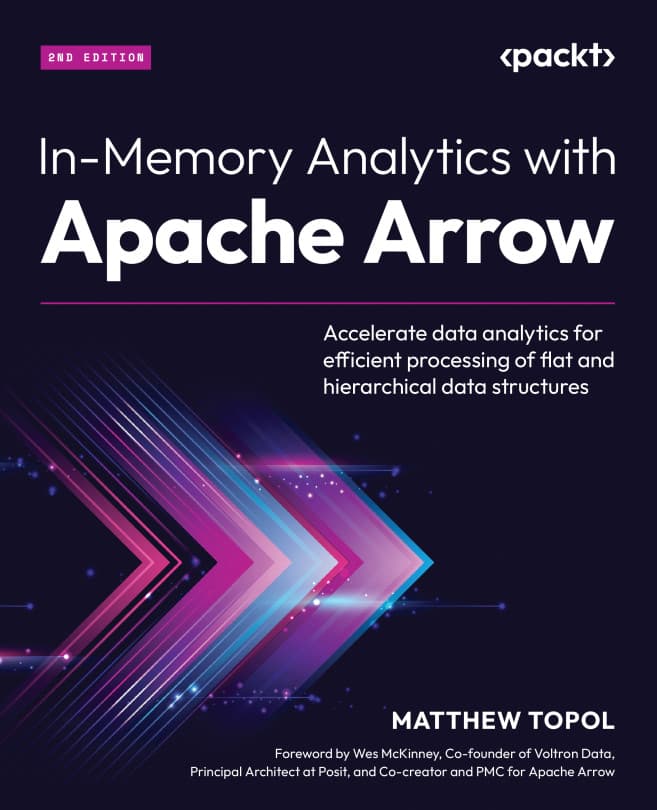
In-Memory Analytics with Apache Arrow
Accelerate data analytics for efficient processing of flat and hierarchical data structures
The second edition explains the columnar memory layout, the compute kernels, Arrow Flight, and Flight SQL. It works through the C++, Go, and Python libraries with runnable examples, and covers nested and hierarchical data in depth. Wes McKinney, a co-creator of Apache Arrow, wrote the foreword.

Apache Arrow PMC member and Co-Founder of Columnar
Apache Arrow FAQ
What is the difference between Apache Arrow and Apache Parquet?
Arrow is an in-memory columnar format optimized for fast computation and zero-copy data exchange. Parquet is an on-disk columnar format optimized for compressed storage. In practice, they work together: data is stored as Parquet on disk and loaded into Arrow arrays in memory for processing. Arrow prioritizes access speed; Parquet prioritizes storage efficiency.
Is Apache Arrow a database?
No, Apache Arrow is a data format specification and a set of libraries. It defines how columnar data is represented in memory and provides implementations in multiple languages (C++, Rust, Python, Java, Go, and others). Databases, query engines, and data science libraries use Arrow as their underlying data representation. Arrow does not include storage, indexing, or query processing on its own.
What does zero-copy mean in the context of Arrow?
Zero-copy means that when data is exchanged between two systems or libraries that both use Arrow, no bytes are copied or transformed. The receiver reads directly from the sender memory buffers. This works because Arrow defines a canonical, language-independent memory layout, so data produced by one system is immediately usable by another without serialization or deserialization.
How does Arrow Flight compare to JDBC and ODBC?
JDBC and ODBC transmit query results row-by-row in a serialized format. Arrow Flight transmits entire record batches as raw Arrow memory buffers over gRPC. For analytical queries that return thousands or millions of rows, Flight has much higher throughput. It avoids per-row serialization overhead and delivers data that is ready for vectorized computation.
Which programming languages support Apache Arrow?
Apache Arrow has native implementations in C++, Rust, Python (PyArrow), Java, Go, JavaScript, C#, Ruby, and Julia. Each implementation produces the same standardized memory layout, so data created in one language can be consumed by any other language without conversion. The C++ and Rust implementations are the most mature and provide the broadest feature sets.
Learn more about Arrow and Spice
Technical resources on how Spice leverages Apache Arrow for zero-copy query execution and high-speed data transport.
Spice.ai OSS Documentation
Learn how Spice uses Apache Arrow as its native data format for zero-copy query execution and high-speed data transport.

How we use Apache DataFusion at Spice AI
A technical overview of how Spice extends Apache DataFusion with custom table providers, optimizer rules, and UDFs.
See Spice in action
Walk through your use case with an engineer and see how Spice handles federation, acceleration, and AI integration for production workloads.
Talk to an engineer